About Cornus kousa Bürger ex Hance
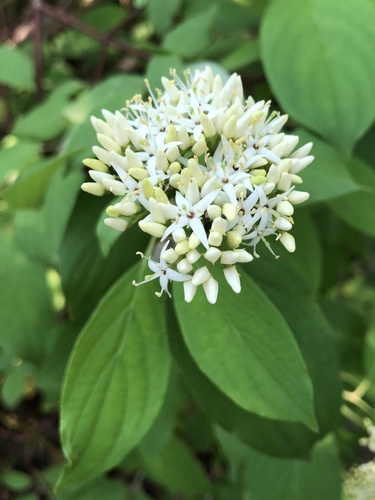
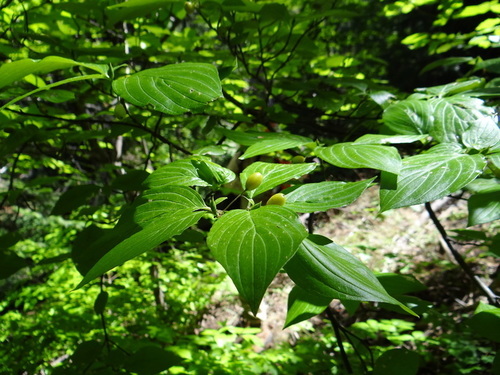
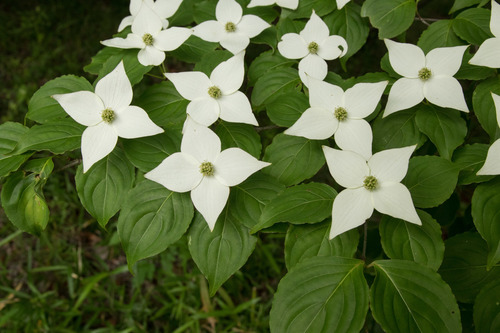
Like other species in the Cornus genus, Cornus kousa has simple, opposite leaves that measure 4 to 10 centimeters long. This tree is extremely striking when in bloom, but the structures that look like four white petals are actually four spreading bracts that sit beneath a cluster of unnoticeable yellow-green flowers. Blooms open in late spring, several weeks after the tree has produced its leaves for the season. It can be told apart from eastern North America's flowering dogwood (Cornus florida) by its more upright growth habit, its blooming period that occurs roughly a month later, and its pointed flower bracts rather than the rounded bracts of C. florida. The fruit of C. kousa is a globose pink to red compound berry, 2 to 3 centimeters in diameter. Berries tend to grow larger as the growing season progresses, and some berry clusters that remain on the tree can grow larger than 4 centimeters across. This fruit is edible, with a sweet, slightly bitter and creamy flavour, and it adds an appealing extra quality to the tree's ornamental value. The fruit is sometimes used to make wine. Unlike C. florida, which is very susceptible to the dogwood anthracnose disease caused by the fungus Discula destructiva and is commonly killed by the disease, C. kousa is resistant to this pathogen. For this reason, C. kousa is widely planted as an ornamental tree in areas impacted by the disease. Its fall foliage is a striking red color. For culinary use, C. kousa produces edible berries. The soft fruit pulp is sweet and has a flavor similar to a ripe persimmon, but hard seeds that are tightly attached to the pulp make direct eating inconvenient. The berry rind is usually discarded for its bitter taste, though it is edible. Seeds are usually not eaten, but can be ground for use in jam and sauces. Young leaves of C. kousa are also edible, though they are consumed less often than the berries.