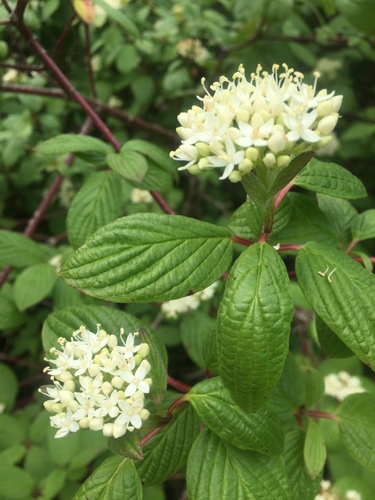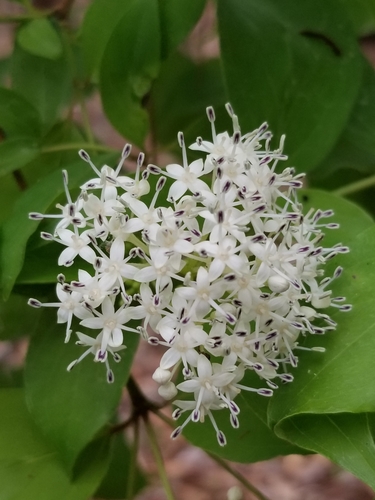
About Cornus foemina Mill.
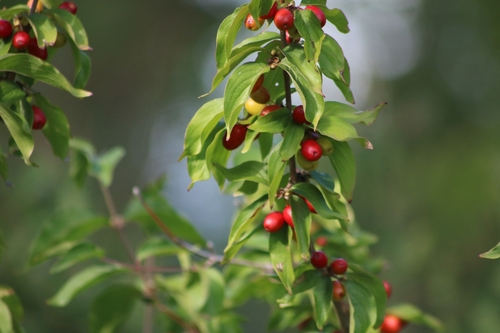
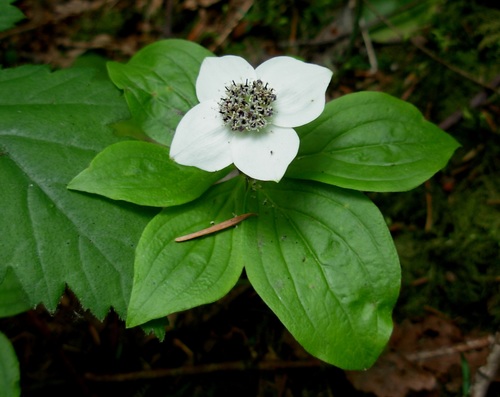
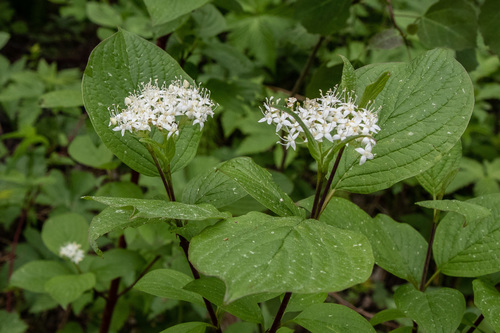
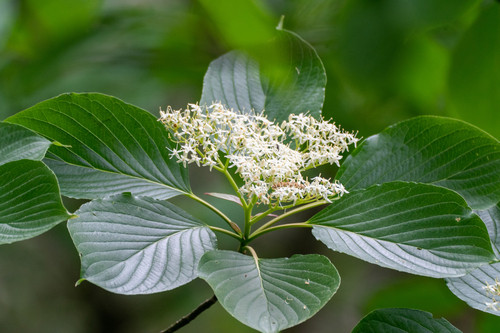
Cornus foemina Mill. is generally classified as a large shrub or a small tree. It can reach a maximum height of 8 meters, with trunks growing up to 10 centimeters in diameter. Its stems grow in clustered arrangements from a single rootstock, and have bark that ranges in color from grey to black. Branchlets are deep red when grown in full sun; shaded branchlets are green to bronze instead. Lenticels on the trunk do not protrude, but the bark typically swells between the lenticels. Leaves are oppositely arranged, with petioles 5–16 millimeters long. Leaf blades measure 3.5–11 centimeters long and 1–6 centimeters wide, and are shaped lanceolate, elliptic, or oblanceolate. Each side of a leaf usually has 3–4 veins. The lower leaf surface has trichomes that are either appressed or slightly raised. This species flowers from March to June. Its flowers are arranged in flat-topped cymes; individual flowers are small, creamy white, and have non-showy bracts that often fall off. Because the bracts are loose and detach easily, collected specimens may appear bractless, leaving only a small scar behind. The fruits are globose drupes that range in color from white to blue or purple. White and blue fruits represent a single morph: fruits are blue when immature and turn white when mature, and they are typically around 5 millimeters in diameter. Cornus foemina occurs most commonly in the southeastern United States, distributed across the southeastern coastal region toward the Mississippi River. Its primary range spans the coastal plain from eastern Virginia to central Florida, west to Louisiana, and north to southeastern Missouri. It typically grows in swamps, stream beds, marshes, coastal plains, and riparian forests, and grows well in poorly drained soils. Individual plants can adapt to a range of soil types from clay to sand. It grows as an understory tree and tolerates heavily shaded conditions, but produces more abundant fruit when grown in strong sunlight. It tolerates both shaded and sunny conditions equally well, with a slight preference for sunny locations. It has good drought tolerance but is prone to physical injury. This species provides food for many animals that live in wet woodlands. White-tailed deer, cottontail rabbits, and beavers browse its leaves. Its fruits are an important food source for birds, including quail, catbirds, mockingbirds, American robins, and brown thrashers, and are also eaten by various songbird species, ducks, squirrels, chipmunks, and raccoons. Its flowers are visited and pollinated by a range of insects including wasps and flies such as Mischocyttarus mexicanus cubicola, Eumenes fraternus, and Copestylum sexmaculatum. Cornus foemina acts as a host for the fungi and moth species Phomopsis, Caloptilia burgessiella, Heterocampa guttivitta, Cecrita guttivitta, and Sarcinella pulchra. It also provides erosion control for local ecosystems. This species is susceptible to powdery mildew disease. For human use, Cornus foemina is suited to many landscaping applications, including rain gardens, drainage swales, flood-prone areas, lake margins, and stream beds. It is chosen for these uses because it grows well in wet conditions, provides erosion control, and does not require high levels of sunlight to thrive. Despite its usefulness, it is rarely available for purchase at garden landscaping centers. It is also a beneficial species for ecological restoration projects, as it is an early successional woody plant. It has been recorded growing at high density within three years in a secondary successional bottomland hardwood forest.