About Cornus drummondii C.A.Mey.
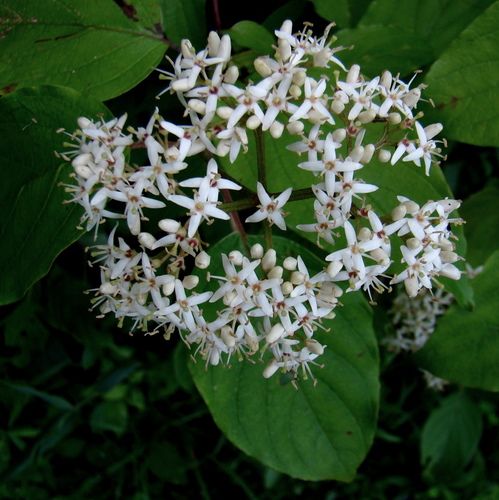
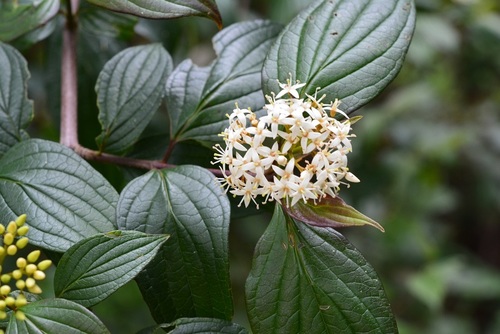
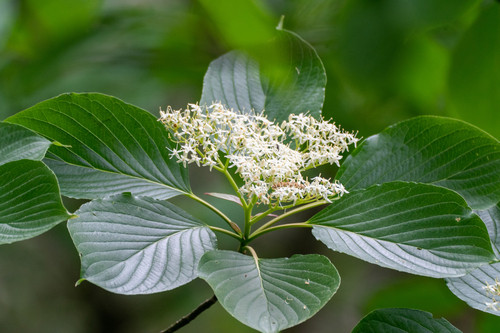
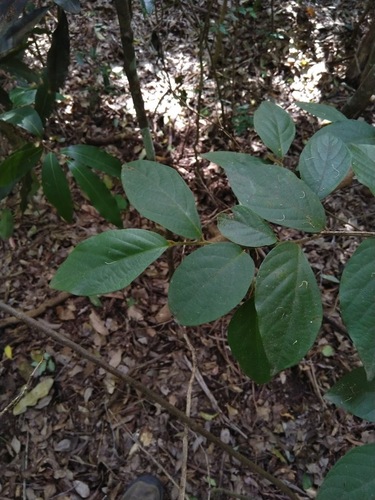
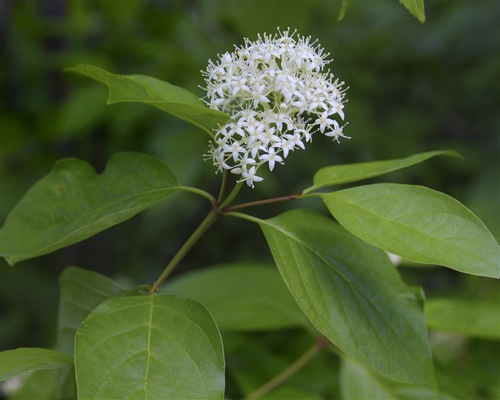
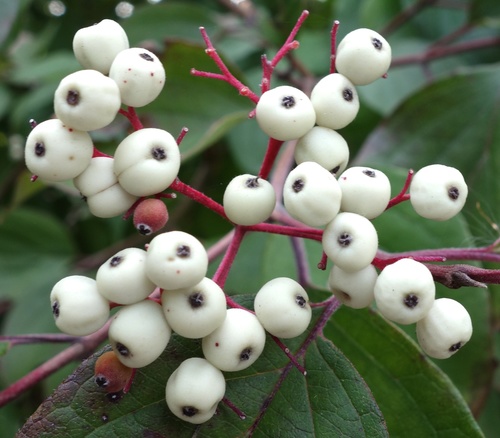
Cornus drummondii C.A.Mey., commonly called roughleaf dogwood, is a deciduous tree in the Cornaceae family. It is uncommon in the wild, and is mostly found around forest borders. Its native habitats include wetlands, mesic and dry-mesic woodlands, riparian forests, and limestone topography, and it commonly forms thickets. Roughleaf dogwood flowers during the summer months, with white flowers blooming from April to July. Its fruit ripens from August to October. Its leaves have 8–25 mm petioles, with blades that range from lanceolate to ovate, measuring 2–12 cm long by 1.2–7.7 cm wide. Leaf bases are cuneate, truncate, or cordate, and leaf apexes are abruptly acuminate. The abaxial (lower) leaf surface is pale green, with dense, upward-curving hairs; the adaxial (upper) leaf surface is gray-green, with upward-curving or appressed hairs. Leaves are ovate with pinnate venation, and overall an olive green color. There are 3–4 (occasionally up to 5) secondary veins per side of the leaf, most arising from the proximal half of the leaf blade. Unlike many other dogwoods, roughleaf dogwood is very adaptable and can grow in a wide range of conditions. It has low water requirements, grows in shaded or partially shaded areas, and will tolerate dry or moist alkaline soil, as well as sandy, sandy loam, medium loam, clay loam, and clay textures. In horticulture, it is recommended to grow Cornus drummondii in full sunlight and well drained soil. It reaches a mature height of 15 to 25 feet (4.6 to 7.6 m) with a spread of 10 to 15 feet (3.0 to 4.6 m). It is used as a buffer planting around parking lots, in highway medians, and near home decks and patios. It is grown as an ornamental tree because it requires little care once mature, thanks to its pest tolerance, low water needs, and shade tolerance. It is also often planted to attract birds, which favor its fruit. In terms of wildlife use, over 40 species of bird eat the fruit of roughleaf dogwood, including mockingbirds, bluebirds, cardinals, wood warblers, yellow-rumped warblers, kinglets, and flycatchers. Flocks of these smaller birds feed on the fruits during fall and winter. Other frugivorous animals that consume the fruit include raccoons, squirrels, deer, rabbits, skunks, and black bears. Frugivory by birds is the most common method of seed dispersal for C. drummondii. Naturally, Cornus drummondii is distributed across the United States from New York in the east to Texas in the west and south, and reaches as far north as Ontario, Canada.