About Cornus canadensis L.
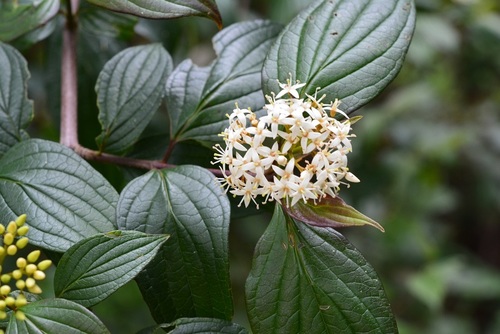
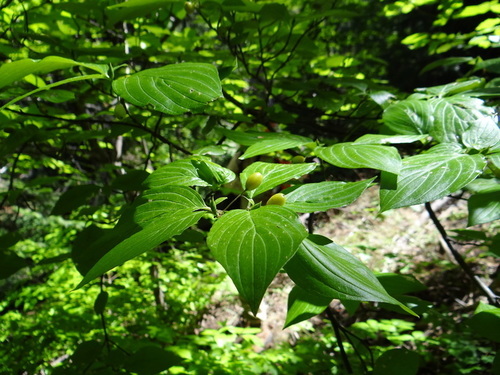
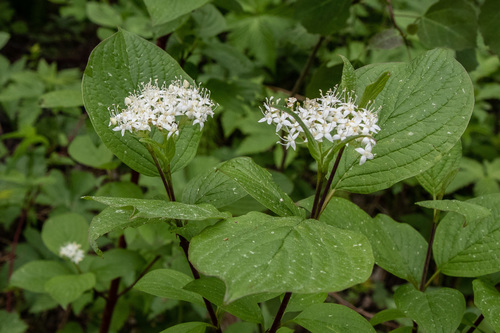
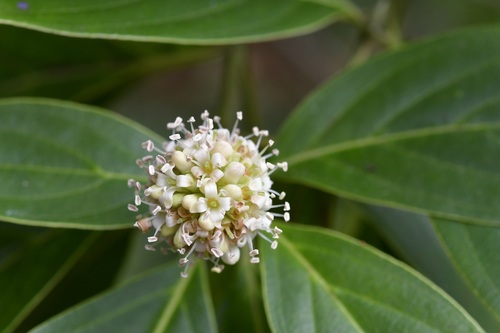
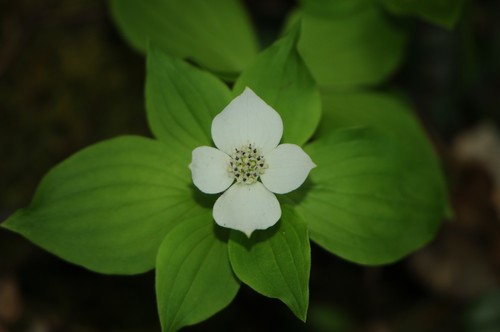
Cornus canadensis L. is a slow-growing herbaceous perennial that reaches 10–20 centimetres (4–8 inches) in height, and typically forms a carpet-like mat. Above-ground shoots grow from slender creeping rhizomes that sit 2.5–7.5 cm (1–3 in) deep in the soil, forming clonal colonies under trees. The vertical above-ground stems are slender and unbranched. Shiny dark green leaves grow near the terminal node, attached by petioles 2 to 3 millimetres (1⁄16 to 1⁄8 in) long. The leaves are arranged oppositely on the stem, clustered in groups of six that often appear to form a whorl due to compressed internodes. Each cluster holds two larger leaves and four smaller leaves; the smaller leaves develop from the axillary buds of the larger leaves. Leaf blades are obovate with entire margins, measuring 3.5 to 7 cm (1+1⁄2 to 3 in) long and 1.5 to 2.5 cm (1⁄2 to 1 in) wide, with 2–3 veins, cuneate bases and abruptly acuminate apexes. In autumn, the leaves develop red-tinted veins before turning entirely red. Its native distribution spans Japan, North Korea, northeastern China (Jilin Province), the Russian Far East, the northern United States, Colorado, New Mexico, Canada and Greenland. This is a mesophytic species that requires cool, moist soils. It grows in montane and boreal coniferous forests, occurring along the margins of moist woods, on old tree stumps, in mossy areas, and other open moist habitats. Birds are the main agents that disperse its seeds, as they feed on its fruit during fall migration. In Alaska, bunchberry is an important forage plant for mule deer, black-tailed deer and moose, which consume it throughout the growing season. It is used as ornamental groundcover in gardens, and prefers moist acidic soil. Wildflower author Claude A. Barr considered the plant's crimson berries even more attractive than its flowers. The fruits are edible raw but have very little flavor, and their pulp does not separate easily from the seeds. The berries can be cooked, strained, combined with other fruits, or used to make pudding.