About Cornus alternifolia L.f.
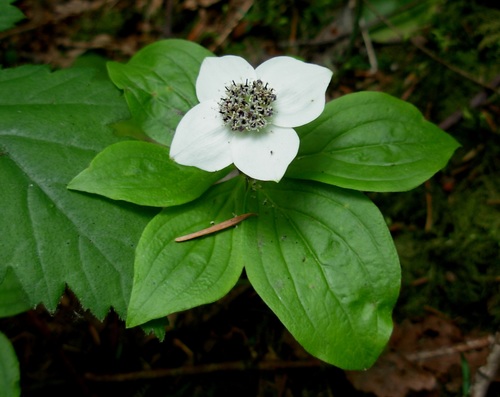
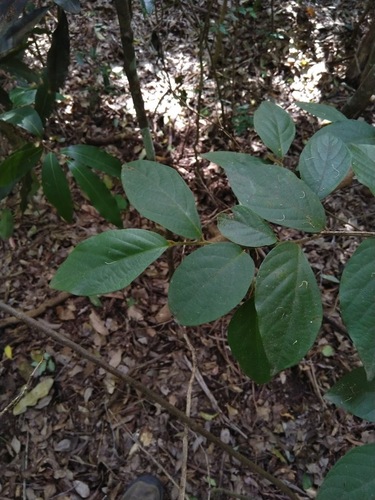
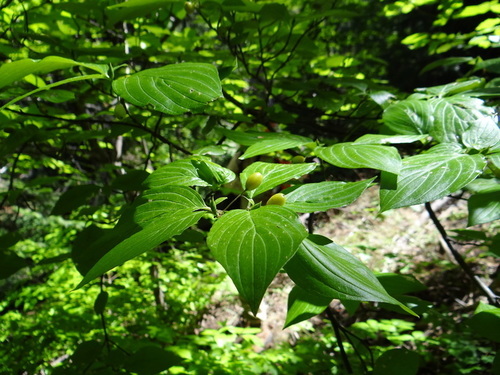
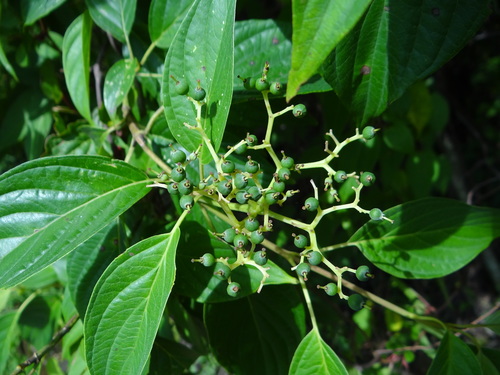
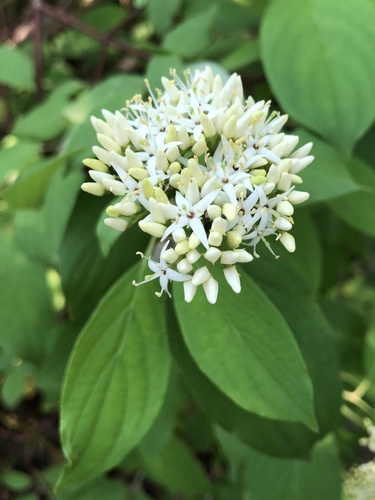
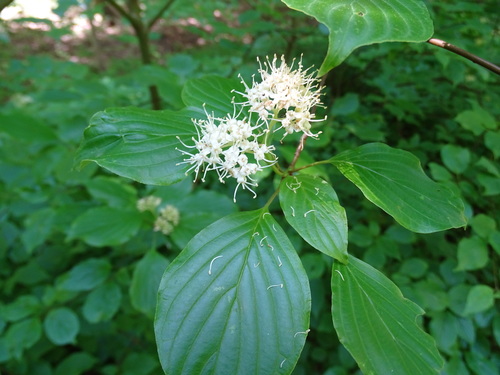
Cornus alternifolia L.f., commonly called alternate-leaf dogwood, is a small deciduous shrub or tree that typically grows 25 feet (8 m) tall, rarely reaching 30 feet (9 m), and grows 20 feet (6 m) to 32 feet (10 m) wide. Its trunk can reach up to 6 inches (152 mm) in diameter. Its branches grow in distinct horizontal, tiered layers separated by gaps, creating a layered, tiered appearance with an overall flat-topped crown that resembles a pagoda. Unlike most species in the Cornus genus, this plant has leaves arranged alternately along stems, rarely opposite. Leaves are most often clustered tightly at the ends of twigs, appearing almost whorled. The leaves are elliptic to ovate, measuring 2–5 inches (5–13 cm) long and 1–2 inches (25–51 mm) broad, with wavy toothed margins, a slightly reflexed edge, and an acuminate apex. The upper leaf surface is smooth and green, while the undersides are hairy and bluish; when fully grown, leaves are bright green above and pale, downy, almost white beneath. In autumn, leaves turn yellow, or a mix of yellow and scarlet. Slender, grooved, hairy petioles with clasping bases attach the leaves to stems. The bark is gray to brown (or dark reddish brown), becoming ridged with age. Young branchlets are first pale reddish green, later turning dark green. The wood is reddish brown with pale sapwood; it is heavy, hard, and close-grained, with a specific gravity of 0.6696 and a weight of 41–73 lb/cu ft (660–1,170 kg/m3). Light chestnut brown, acute winter buds form; their inner scales enlarge with the growing shoot, reaching half an inch long before falling. Small cream-colored perfect flowers bloom in April and May, each with four small oblong petals with rounded ends. The flowers are borne in many-flowered, broad open cymes, with inflorescences 2–5 inches (5–13 cm) across. The flowers have four stamens arranged alternately with the petals, exserted with long slender filaments and oblong, introrse, versatile two-celled anthers that open longitudinally. The ovary is inferior and two-celled, with a columnar style and capitate stigma. The fruit is a globose blue-black drupe 0.3 in (8 mm) across, tipped with the remnant of the style sitting in a slight depression, and contains an obovoid, many-grooved nut; fruit ripens in October. This species is found growing in the understory of open deciduous forests, along forest margins, and alongside swamp margins, and also occurs in younger forests. It prefers moist, well-drained soil; its seedlings are shade-tolerant, and it is common as an understory tree in mature forests dominated by sugar maple (Acer saccharum) or aspen (Populus). Its fruits provide food for at least eleven species of birds and black bears. White-tailed deer, beaver, and cottontail rabbit eat its leaves and bark. It is a pollinator plant that attracts and supports bees, flies, and butterflies, and acts as a host plant for butterflies, providing food for their larval stage. Due to its attractive wide-spreading tiered branches and flat-topped crown, it is often used as an ornamental in landscape plantings. Unlike flowering dogwood, its flower clusters do not have a large white involucre, and its fruit is dark purple rather than red. The cultivar 'Argentea', also called silver pagoda dogwood, has received the Royal Horticultural Society's Award of Garden Merit, confirmed in 2017. Cornus alternifolia is susceptible to golden canker caused by the pathogen Cryptodiaporthe corni, especially when stressed by drought or heat. siting the plant in partial to full shade, with adequate mulch and water, reduces the incidence of this disease. It has been used in traditional Chinese medicine as a tonic, analgesic, and diuretic.