About Cornu aspersum (O.F.Müller, 1774)
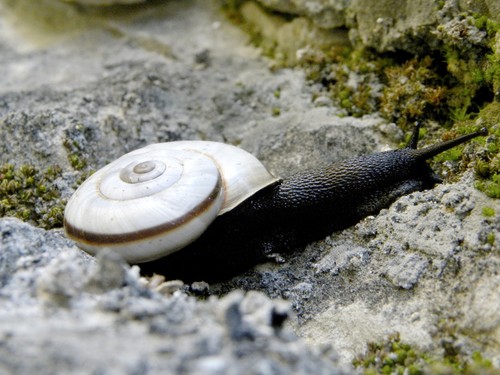
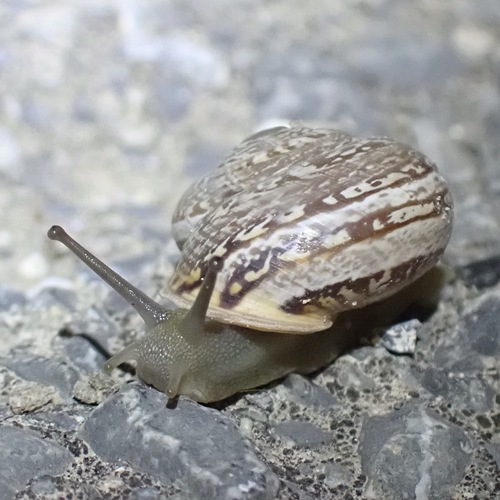
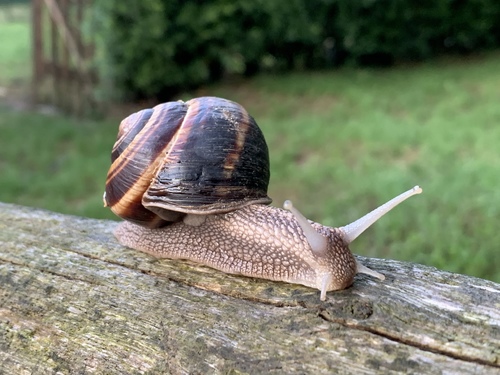
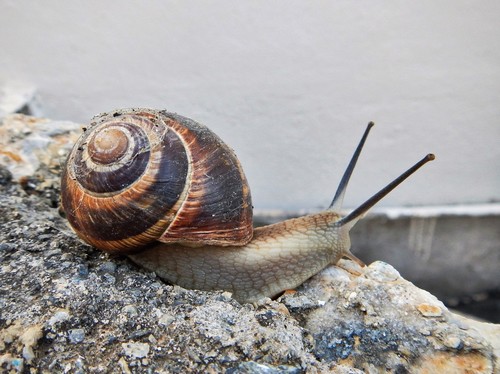
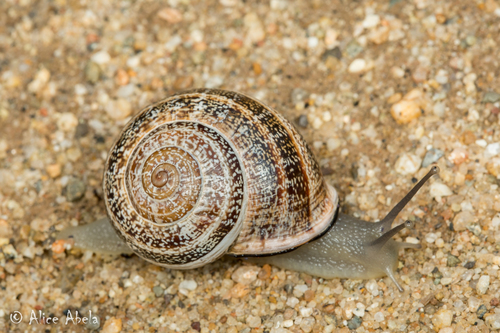
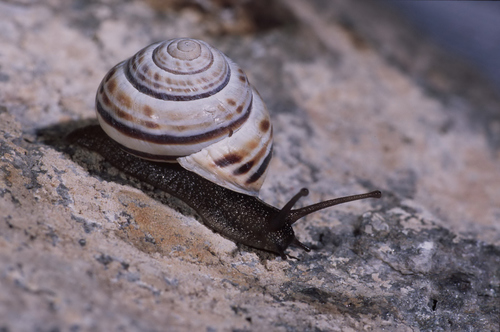
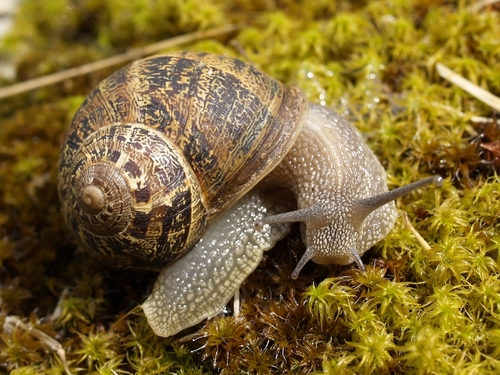
This is a description of the land snail species Cornu aspersum (first described by O.F.Müller in 1774). Adult individuals have a hard, thin calcareous shell that measures 25–40 mm (1–1 5/8 inches) in diameter and 25–35 mm (1–1 3/8 inches) in height, with four or five whorls. Shell color and shade vary widely, but most shells have a reticulated pattern in dark brown, brownish-golden, or chestnut, marked with yellow stripes, flecks, or streaks, and typically have interrupted brown color bands. The shell aperture is large and characteristically oblique, and its margin is whitish and reflected in adult snails. The snail's soft body is slimy and brownish-grey, and can be fully retracted into the shell when the snail is inactive or threatened. When injured or strongly irritated, the snail produces a defensive froth of mucus that can repel some enemies or overwhelm aggressive small ants and similar small animals. This species has no operculum; during dry or cold weather, it seals the shell aperture with a thin membrane of dried mucus called an epiphragm, which helps the snail retain moisture and protects it from small predators such as some ants. Quiescent periods during heat and drought are called aestivation, while quiescence during winter is called overwintering. When overwintering, Cornu aspersum avoids ice formation in its tissues by altering the osmotic components of its blood (haemolymph), allowing it to survive temperatures as low as −5 °C (23 °F). During aestivation, the mantle collar can change its water permeability, and the snail also has an osmoregulatory mechanism that prevents excessive water absorption during hibernation. These adaptations protect the snail from fatal desiccation or overhydration during months of quiescence. When active, the snail extends its head and muscular foot out of the shell. The head has four tentacles: the upper two are larger and bear eye-like light sensors, while the lower two function as tactile and olfactory sense organs. The snail extends its tentacles using internal body fluid pressure, and retracts all four tentacles into the head by invagination when threatened or when retreating into the shell. The mouth is located beneath the tentacles, and holds a chitinous radula that the snail uses to scrape and manipulate food particles. The shell of Cornu aspersum is almost always right-coiled, though rare left-coiled specimens are known, the most famous example being Jeremy the snail. Cornu aspersum is native to the Mediterranean region; its native range extends from northwest Africa and Iberia, east to Asia Minor and Egypt, and north to Britain. This is an anthropochorous species, meaning it has been spread to many regions by humans, either deliberately or accidentally. It is now cosmopolitan across temperate zones, and has become naturalized in regions with different climates from the Mediterranean climate where it evolved. Passive spread by humans is the most likely explanation for genetic similarities between geographically separated allopatric populations. This anthropochorous spread may have started as early as the Neolithic Revolution around 8500 years before present, and continues today, sometimes causing local catastrophic destruction of habitats or crops. Its expanding non-native distribution includes parts of Europe, such as Bohemia in the Czech Republic, where it has been present since 2008. It is also found in Australia, New Zealand, North America, Costa Rica, and southern South America. It was introduced to Southern Africa as a food animal by Huguenots in the 18th century, and to California as a food animal in the 1850s; it is now a well-known agricultural pest in both regions, especially in citrus groves and vineyards. Many jurisdictions enforce quarantines to prevent the importation of this snail in plant material. Several endemic North African forms and subspecies have been described based on shell characteristics. The subspecies Cornu aspersum aspersum, commonly called 'petit gris' in French, is native to the Mediterranean area and Western Europe, but has been widely spread to other regions. The name Cornu aspersum maximum has been used for a large form raised in snail farming (called 'gros gris' in French), but this form is genetically distinct from the large Algerian forms that were originally given this name. Like other pulmonate gastropods, individual Cornu aspersum are hermaphrodites that produce both male and female gametes. Reproduction is predominantly, and likely exclusively, done by outcrossing. During a several-hour mating session, two snails reciprocally exchange sperm. Mating individuals stab a calcite spine called a love dart into their partner. The mucus coating the love dart contains a chemical that keeps sperm from being digested, which is important for sperm competition because individuals mate repeatedly, and donated sperm can remain viable for 4 years. Around 10 days after fertilization, the snail lays a clutch of an average of 50 spherical, pearly-white eggs into crevices in topsoil, or in sheltered spots under stones. A single snail can lay approximately six clutches of eggs in one year. The eggs measure 3 mm in size. After hatching, snails take one or more years to reach maturity: maturity takes two years in Southern California, but only 10 months in South Africa. In captivity, snails can reach sexual maturity as early as 3.5 months after hatching, before they stop growing. The typical lifespan of Cornu aspersum in the wild is 2–3 years. Cornu aspersum is primarily a herbivore. It feeds on many types of fruit trees, vegetable crops, rose bushes, garden flowers, and cereals. It is also an omnivorous scavenger that feeds on rotting plant material, and will occasionally scavenge animal matter such as crushed snails and worms. It can get the calcium it needs to build its shell by consuming soil. In turn, Cornu aspersum is a food source for many other animals, including small mammals, some bird species, lizards, frogs, centipedes, predatory insects such as glowworms in the family Lampyridae, and predatory terrestrial snails. This species can be used as an indicator of environmental pollution, because it deposits heavy metals such as lead in its shell.