About Cormus domestica (L.) Spach
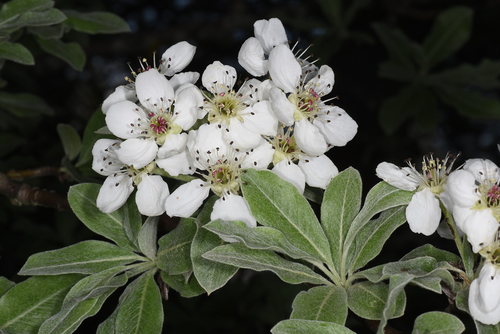
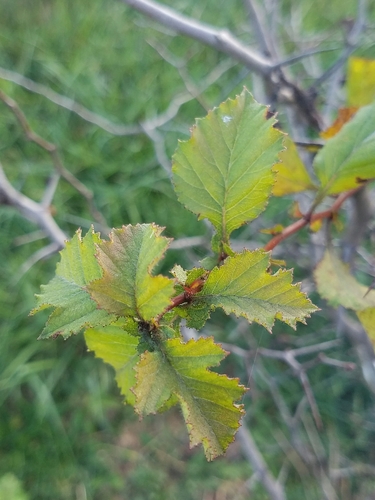
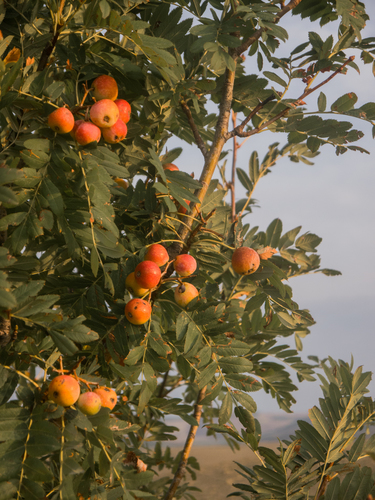
Cormus domestica (L.) Spach, commonly known as the service tree or sorb tree, is a tree species native to western, central and southern Europe, northwest Africa (the Atlas Mountains), and southwest Asia, ranging east to the Caucasus. It is sometimes called the true service tree to distinguish it from the wild service tree (Torminalis glaberrima), and it is the only species in the monotypic genus Cormus. This is a deciduous species that typically grows as a 15–20 m (49–66 ft) tall tree, very rarely reaching 30 m (98 ft) tall, with a trunk up to 1 m (3 ft 3 in) in diameter. On exposed sites, it may instead grow as a shrub 2–3 m (6.6–9.8 ft) tall. Young trees have smooth brown bark, which becomes fissured and flaky as the tree ages. Its winter buds are green and covered in a sticky, resinous coating. Its leaves are 15–25 cm (5.9–9.8 in) long, and are pinnate, made up of 13–21 individual leaflets. Each leaflet is 3–6 cm (1.2–2.4 in) long and 1 cm (0.39 in) broad, with a bluntly acute apex, and serrated margins along the outer half to two thirds of the leaflet. The flowers are 13–18 mm (0.51–0.71 in) across, with five white petals and 20 creamy-white stamens. They grow in corymbs 10–14 cm (3.9–5.5 in) in diameter during late spring, are hermaphrodite, and are pollinated by insects. The fruit is an edible pome 2–3 cm (0.79–1.18 in) long, called a "serviceberry". It is greenish-brown, often with a red tinge on the side exposed to sunlight, and may be either apple-shaped (form pomifera (Hayne) Rehder) or pear-shaped (form pyrifera (Hayne) Rehder). Cormus domestica is generally a rare species. It is listed as endangered in Switzerland and Austria, and uncommon in Spain. In the United Kingdom, a very old tree that grew in the Wyre Forest until it was destroyed by fire in 1862 was once considered native, but it is now most often thought to be of cultivated origin, likely planted in a medieval monastery orchard. More recently, a small population of confirmed wild specimens was found growing as stunted shrubs on cliffs in south Wales (Glamorgan) and nearby southwest England (Gloucestershire). It remains a very rare species in Britain, found only at a small number of sites. Its largest English population is located within the Horseshoe Bend Site of Special Scientific Interest at Shirehampton, near Bristol. An additional wild population has been found growing on a cliff in the upper Camel Estuary, Cornwall. This is a long-lived species; some specimens in Britain are estimated to be 300–400 years old. One of the largest and likely oldest known specimens in Europe grows alongside an educational trail near the town of Strážnice in Moravia, Czech Republic. Its trunk has a circumference of 462 cm (15.16 ft), its crown measures 11 m (36 ft) high and 18 m (59 ft) across, and it is estimated to be around 450 years old. The fruit of Cormus domestica is used as an ingredient in a cider-like drink that is still produced in parts of Europe. When picked directly from the tree, the fruit is highly astringent and gritty, but after it is left to blet (overripen), it sweetens and becomes pleasant to eat. In the Moravian Slovakia region of the Czech Republic, there is a community-run museum with an educational trail and a festival dedicated to this tree, and local producers make jam, juice and brandy from its fruit. The sorb tree is mentioned in the Babylonian Talmud in Ketubot 79a, with a reference to a "thicket of zardəṯā" in Jewish Babylonian Aramaic. In ancient Greece, the fruit was cut in half and pickled; in Plato's Symposium (190d7-8), Aristophanes uses this pickled fruit as a metaphor for Zeus cutting the original spherical humans in half. Wood from the service tree was commonly used to make wooden planes of all types for working wood, because it is relatively dense and holds a shaped profile well.