About Cormocephalus rubriceps Newport, 1843
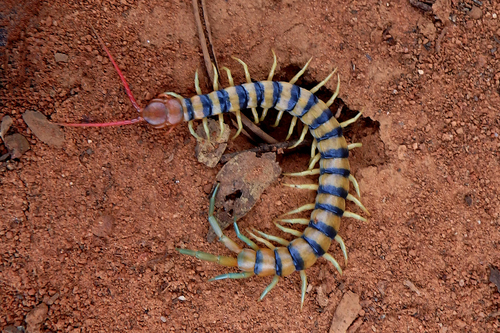
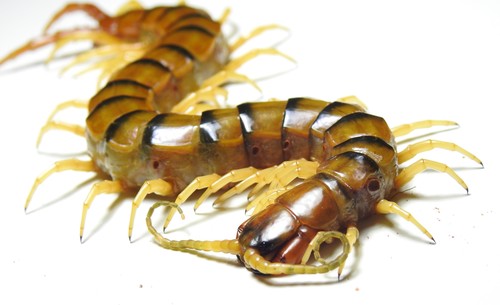
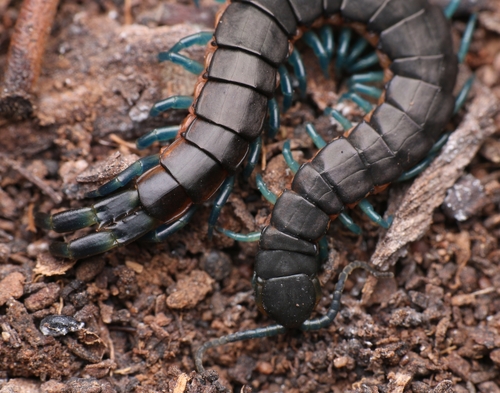
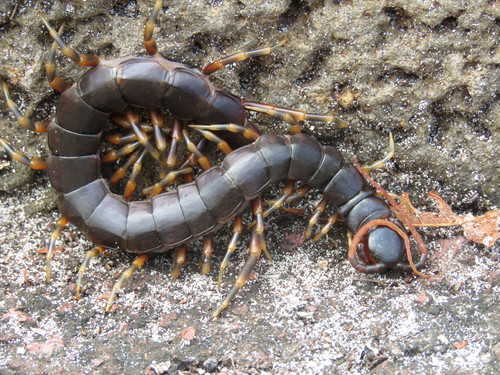
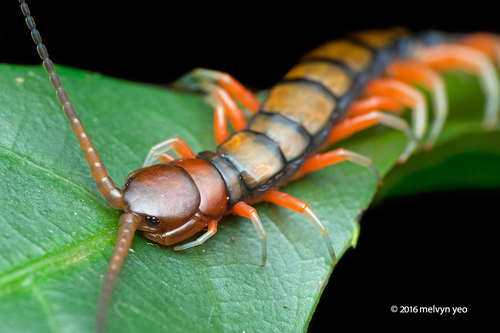
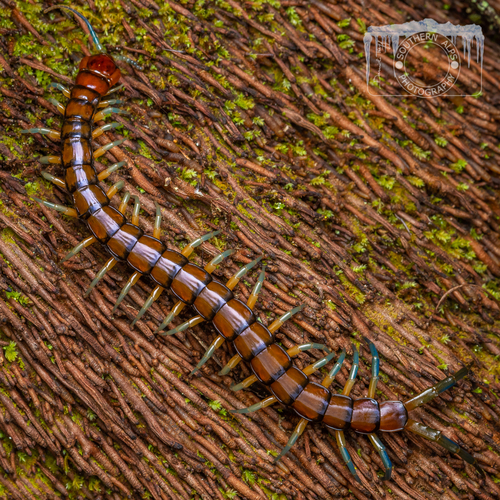
Cormocephalus rubriceps is a very large centipede species, with individuals sometimes exceeding 20 centimetres (8 in) in length. Australian individuals are considerably smaller, usually reaching a maximum of only 3.9 centimetres (1.5 in) in length. This species has 21 body tergites (upper body plates) and 21 sternites (lower body plates). Its head and first tergite are reddish-brown, while all other tergites are olive-brown. Two grooves run from the base of the head, stopping just before the midpoint of the head. It has large black forcipules, which are fang-like appendages. Its antennae are long and have seventeen segments; the first five segments are smooth, and the remaining segments are hairy. The first tergite is smooth except for sparse punctures, while all other tergites up to the twentieth have a faint pair of lengthwise grooves across their surfaces. The legs are yellowish at the base, fading to green towards the tip, and the ultimate legs have light blue tips. Two spines are present at the base of the leg claws. The second leg segment of the ultimate legs lacks several rows of spines that are found in some other Cormocephalus species. C. rubriceps is native to New Zealand and Australia. In Australia, it has been recorded around Perth in the west, Adelaide in the south, and Sydney and Brisbane in the east. Previous records from Tasmania are now considered to be an error. Within New Zealand, it is widespread across the North Island, including on several offshore islands such as Manawatāwhi / Three Kings Islands and Poor Knights Islands. On Great Island in the Three Kings group, the species is reportedly so common that visiting researchers surrounded their sleeping bags with tinfoil to get alerts when centipedes approached. It lives in damp habitats including rotten logs and leaf litter, but is also occasionally found in caves. It qualifies as a trogloxene, meaning it can survive in a cave environment but cannot permanently reside there. Like all centipedes, C. rubriceps is a predator. In captivity, it feeds on orthopterans including the tree wētā Hemideina thoracica, the katydid Caedicia simplex, and the black field cricket Teleogryllus commodus. It also feeds on other groups of invertebrates including spiders, moths, earwigs, and other centipedes. In the wild, it reportedly even preys on small reptiles, and one study has proposed that it may feed on young tuatara. Females of this species are protective of their young. Two different hunting strategies have been observed: in one, the centipede raises the rear section of its body and grabs approaching prey with its hind legs, then curls its body around the prey, bites it, and begins feeding. In the other, the centipede catches prey with its legs and suspends the prey upside down before feeding. Very little of the prey remains after feeding is complete. In New Zealand, C. rubriceps is eaten by introduced exotic pests including Polynesian rats, Norway rats, and European hedgehogs. As a result, the species is most abundant in areas where these predators have been eradicated or never became established, such as isolated island habitats. It is also preyed upon by the North Island brown kiwi.