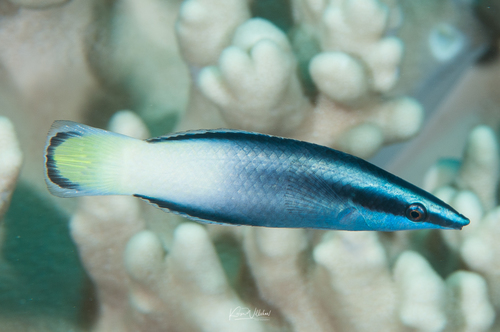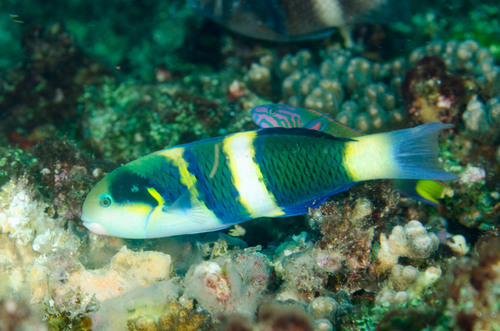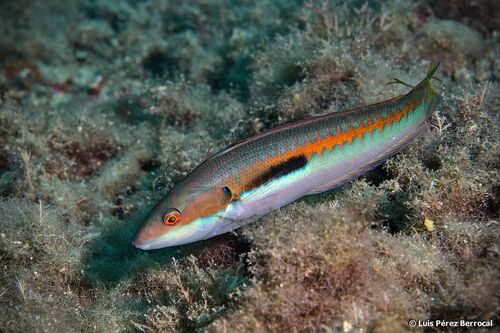
About Coris julis (Linnaeus, 1758)
Coris julis, first described by Linnaeus in 1758, has a consistent body shape across all individuals, which is either long and slender, slightly compressed, or fusiform. While secondary males of the species grow longer than other individuals, all share flexible bodies that enable sharp turns. They swim primarily using their pectoral fins, relying on their caudal and ventral fins for stability. This species has a slightly oblique terminal mouth, with recurved canine teeth on both the upper and lower jaws. Extra space in the upper jaw allows the lower jaw to fit fully when the mouth is closed. The second canine tooth is two-thirds the length of the first, and is also recurved. Behind the canines, the upper jaw holds 9 to 11 additional teeth that grow progressively smaller and less pointed. The lower jaw follows the same pattern, but only holds 9 to 10 additional teeth behind the canines. Each upper pharyngeal plate contains 15 to 25 conical, blunt teeth. Three molars sit on the posterior side of the median edge; the largest of these molars is twice the size of the second largest. Like other teleost fish, Coris julis has cycloid scales, which evolved from ganoid scales. These scales grow with the fish, forming growth rings similar to those of trees that can be used to determine the fish's age. The overlapping arrangement of cycloid scales increases the fish's body flexibility. Scales cover the fish's chest and sides, growing smaller moving ventrally toward the belly and anteriorly toward the head. Lateral line scales are roughly equal in size, except for the last pored scale at the base of the caudal fin, which is larger. No scales are present at the base of the dorsal fin, which starts at the 5th lateral line scale, nor at the base of the anal or paired fins. Scales cover roughly one-fifth of the caudal fin. Coris julis has 8 to 10 dorsal spines, 12 soft dorsal fin rays, 3 anal spines, 11 to 12 soft anal rays, 12 pectoral rays, and 72 to 74 lateral line scales. There are 4 to 6 cephalic pores, small openings that form part of the lateral line sensory system, on the snout. Geographically, Coris julis is found in the Mediterranean Sea, where it has an apparently even distribution. It can also be found as far north as Norway and as far south as Senegal. Further south in Western-central Africa, the less widespread related species Coris atlantica replaces it. These two species are the only members of the genus Coris found in the Eastern Atlantic; the remaining 26 species in the genus live in the Indo-Pacific. One study has proposed splitting Coris julis into two separate species: C. julis and C. menalura. Ecologically, C. julis typically inhabits rocky or sandy ocean floor substrates, and is very common in seagrass beds. Between sunset and sunrise, it buries itself in sand. It lives in shallow coastal waters, with a standard depth range of 0 to 50 meters, and extreme recorded depths from 0 to 120 meters. Coris julis is a diandric protogynous hermaphrodite: this means the species has two categories of males, and individuals change sex from female to male as they mature. During mating, terminal males swim rapidly with their dorsal fins held erect, making short up-and-down movements as part of the mating ritual. Both male phases are able to mate, but secondary males, which have undergone sex reversal from female to male, have higher spawning success rates. After mating and fertilization, eggs hatch approximately two days later. Larvae live among zooplankton for around one month, then sink to the ocean floor to enter their juvenile stage. In the Balearic Islands, Coris julis is reproductively active between May and July. This seasonal reproductive strategy lets the species allocate resources to growth for the rest of the year without reducing reproductive success. Sex inversion occurs after the spawning season, between August and December. When sex change happens, a shift in body color occurs at the same time, which is common for species in the Labridae family. During sex reversal, spermatogonial nets develop along the ovarian wall and spread inward, making it difficult to distinguish secondary males, which changed sex, from primary males, which were male at first maturation and never underwent sex inversion. All stages and sexes of Coris julis are functionally reproductive.