About Coris cuvieri (Bennett, 1831)
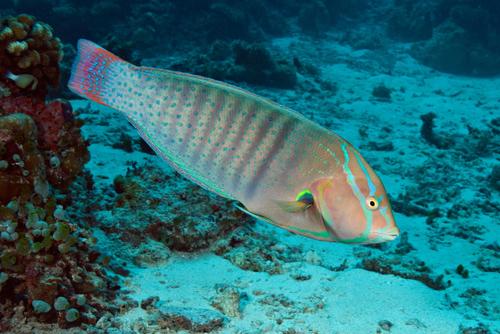
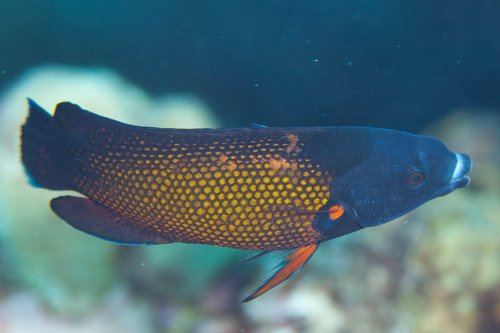
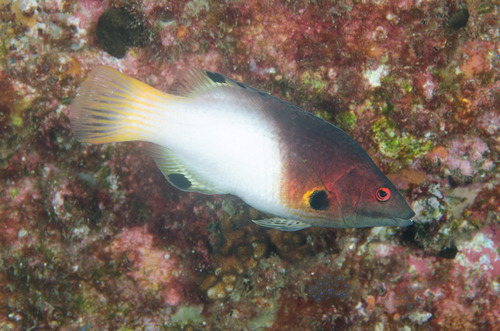
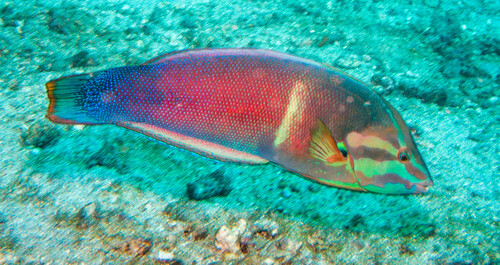
Coris cuvieri reaches a maximum total length of 38 centimetres, or 15 inches, which is slightly longer than the closely related species Coris gaimard. Its body has a dull orange-brown base color marked with green patterns that become more distinct as the fish matures. Each individual body scale has a green spot that contrasts with the fish's dark reddish body. Adult males have yellow and blue markings on their head and face, plus a greenish-white vertical stripe positioned in the middle of the body; this stripe is not present in females. Juvenile Coris cuvieri are bright orange-red, similar in appearance to juvenile C. gaimard. They have five black-edged white patches running along their back from the snout to the caudal peduncle, and differences between the two species become visible as juveniles grow. This species was first formally described in 1831 by naturalist Edward Turner Bennett as Julis cuvieri, with its type locality recorded as Mauritius. Its specific name honors French naturalist Georges Cuvier, who lived from 1790 to 1832. Cuvier had originally described this fish under the name Julis aygula, and Bennett later recognized it as a distinct separate species. Coris cuvieri is distributed in the Indian Ocean and the Red Sea. Its range extends from the southern Arabian Peninsula down the eastern African coast to 30°S in South Africa, and eastward as far as Sumatra and Bali. It lives on exposed outer reef flats, in lagoon reefs, and along the seaward edges of reefs, in areas with a mixed substrate of sand, coral, and rubble. Juvenile fish are found in small tidal pools and on exposed reef flats that have algae-covered rubble. This is generally a solitary species. It feeds mostly on hard-shelled prey including crustaceans, mollusks, and sea urchins. While foraging, it turns over rocks to search for hidden invertebrates. Coris cuvieri is oviparous. When breeding, males and females form mating pairs. A single dominant male will guard a harem made up of several smaller females. This species is harvested for the aquarium trade, though the similar Coris gaimard is preferred for this use. Juveniles of the two species are very similar in appearance and are often confused with one another.