About Coris aygula Lacepède, 1801
Scientific name: Coris aygula Lacepède, 1801
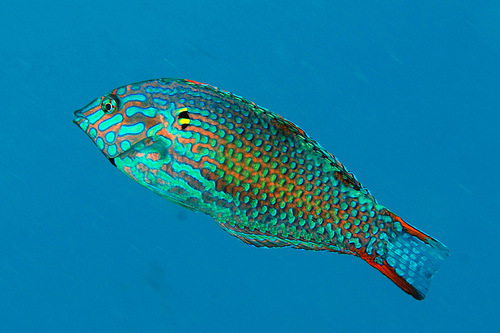
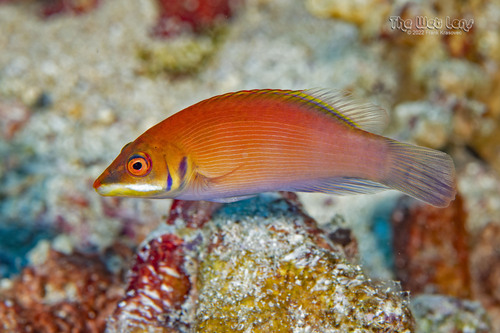
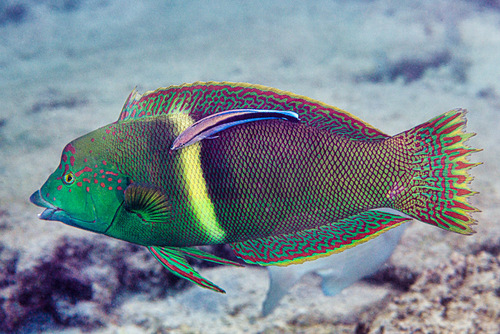
This species can reach a total length of 120 cm (47 in). There is a striking difference in appearance and coloration between juveniles and adult individuals. Juveniles have white and orange coloration, and bear false eyes on the dorsal fin. Adults are uniformly dark green, or may have light banding. Adults also grow a prominent projecting forehead.
In the Indian Ocean, C. aygula ranges from the Red Sea and the African coast eastward to the Line Islands and Ducie Island in the Pacific Ocean. Its Pacific distribution also extends from southern Japan south to Lord Howe Island.
C. aygula lives on coral reefs, and prefers areas with rubble or sandy bottoms, found at depths between 2 and 30 m (6.6 to 98.4 ft). Juveniles of this species are often found in tide pools. Adult individuals are generally solitary.
Studies conducted at Ningaloo Reef in Western Australia found that clown coris are important predators of burrowing urchins. These fish feed on the urchins by crushing them with their jaws. In the Red Sea, however, clown coris have been observed preying on long-spined Diadema urchins by picking the urchins up and bashing them apart against large rocks, instead of crushing them directly with their jaws.