About Coriocella nigra Blainville, 1824
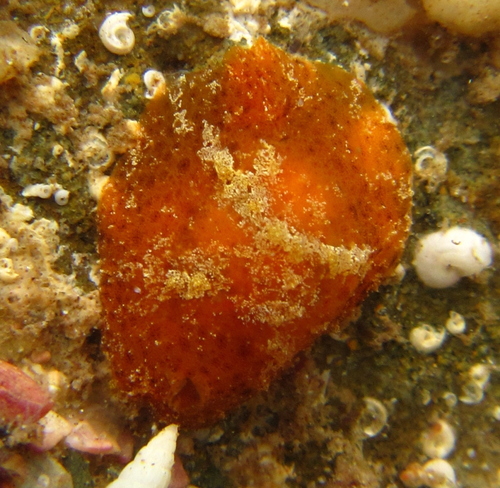
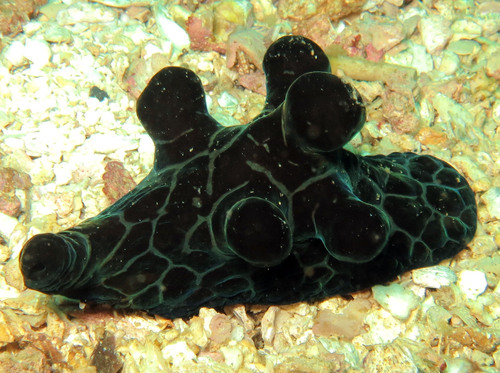
This species, Coriocella nigra Blainville, 1824, has body color that ranges from uniformly velvety black to brown. Its mantle is broadly tuberculate, with delicate borders that are notched at the front and spread widely. The foot is small and oval, and the front of the foot is grooved. There are four or five lobes or bosses on the dorsal part of the body, and an inhalant siphon extends from the middle of the front of the body. Its tentacles are triangular, granulated, and spotted with white, with brown eyes located at their base. The mouth contains a jaw and a radula that holds 48 teeth. Typical body length is around 80 mm, with overall body length ranging from 15–18 mm up to 10 cm. For individuals with a body length of 15–18 mm, body width measures 8–10 mm. Like all members of the family Velutinidae, C. nigra has an internal, reduced shell and a spirally rolled radula. The shell is conchinous, with 2½ or three whorls. The whorls expand rapidly, and the last whorl covers four fifths of the shell's total height. The shell is translucent white, smooth, and marked with irregular growth lines, and it has a large aperture. For a shell that is 10 mm long, shell width is 6.3 mm, and total shell length ranges from 10 mm to 30–40 mm. Coriocella nigra is distributed across the Indo-Pacific region, with recorded occurrences in South Africa, Mozambique, Kenya, Madagascar, Mauritius, Réunion, Mayotte, the Gulf of Aden, the Gulf of Aqaba, South Button Island, Myanmar, Thailand, Indonesia, Papua New Guinea, northern Australia, eastern Australia, the Philippines, Palau, the Society Islands in French Polynesia, New Caledonia, Japan, and Hawaii. Its type locality is Isle de France, which is Mauritius. C. nigra inhabits rocky environments. In Hawaii, it lives among Halimeda kanaloana, and in Australia it occurs in intertidal and subtidal zones. It has been recorded at depths ranging from 1–4 m up to 12 m and 15 m. This species is carnivorous; its probable prey are tunicates, including members of the family Didemnidae in Hawaii. Its fecal pellets are oval and layered, and sclerites from Octocorallia have been found in its gut. The ostracod Pontocypria coriocellae occasionally lives as a commensal in the oral tube of C. nigra. The empty shell of C. nigra is sometimes used by the hermit crab Clibanarius virescens. Two staurosporines, 4′-N-demethyl-11-hydroxystaurosporine and 3,11-dihydroxystaurosporine, have been isolated from C. nigra.