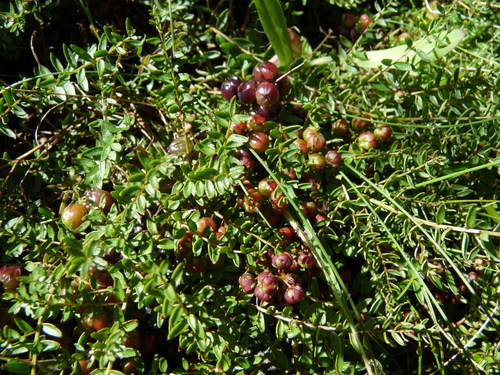
About Coriaria angustissima Hook.fil.
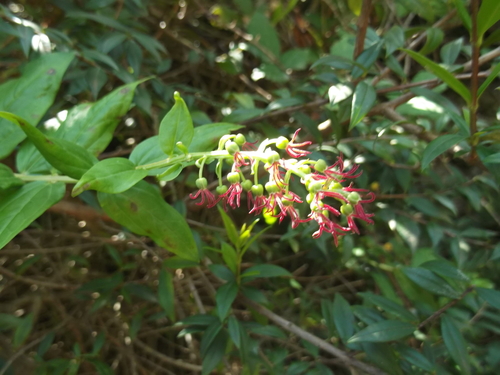
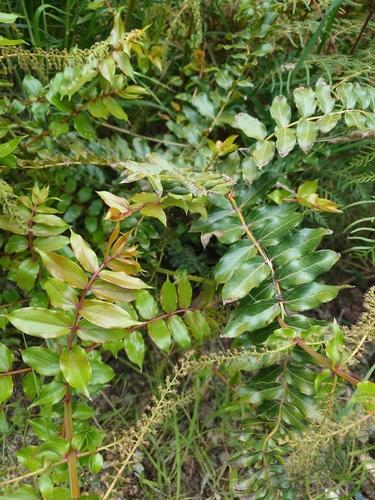
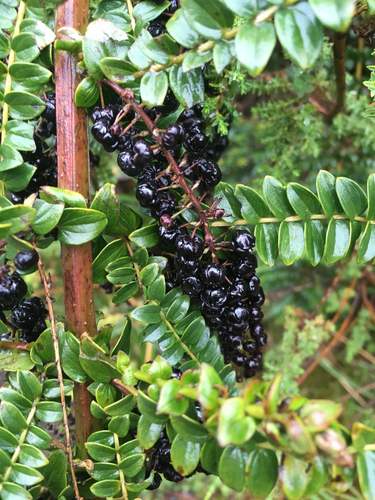
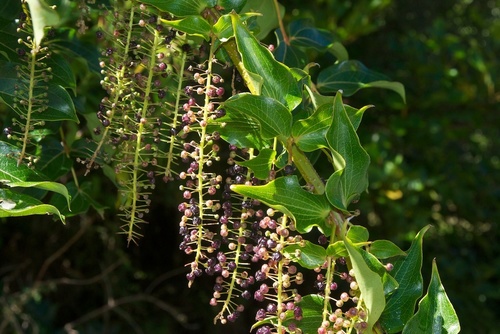
Commonly called small-leaved tutu, Coriaria angustissima Hook.fil. is a bushy shrub native to New Zealand. This species is recognized for its narrow, thread-like leaves. It grows many erect, soft-branched growths that have a square cross-section, and the branches have a feathery appearance from the dark green, thin, pointed leaflets. These leaflets typically measure 7–10 mm long and 1–2 mm wide. The plant produces tiny, bell-shaped downward-hanging flowers, where petals are roughly the same size as the green sepals. Its black fruit grows in short spikes, and each fruit contains ten achenes. This species is endemic to New Zealand. It occurs mainly in wet highland areas of southern New Zealand, especially along the western side of the Southern Alps and on Stewart Island. Small-leaved tutu is a subshrub that grows in subalpine and subarctic biomes, at altitudes ranging from 300 m to 1500 m. It thrives in open woodlands with well-drained soils, where its roots can spread extensively. It typically takes around one year for small-leaved tutu to reach full maturity. Its seeds usually germinate after rainfall, most often in spring or early summer. The seeds have a hard outer coat and may require a period of dormancy during cold months, when colder temperatures lower metabolic activity, before they can germinate. After germination, seeds enter a seedling stage where they develop roots and shoots; during this stage, the plant is especially vulnerable to drought but adapts to the harsh local environment. Next, the plant enters a phase of vegetative growth, where leafy branches develop along with a woody, tangled structure sturdy enough to withstand windy conditions. Coriaria angustissima is dioecious, meaning male and female flowers form on separate individual plants. After pollination, female plants produce small, fleshy, dark purple to black berries. These berries are somewhat toxic to humans, but are eaten as food by various bird species. The berries typically ripen between November and February, after which seeds are dispersed when birds consume the fruit. Coriaria angustissima can reproduce sexually via seed germination, and can also produce new shoots from its existing root system, allowing the plant to spread across areas with favorable conditions. There are recorded cultural uses of tutu plants including this species by Māori people. Tutu-based concoctions may have been used in traditional Māori medicine: mixtures of multiple herbs including tutu were used to treat insanity, used as laxatives, and more commonly used as bandages for wounds and fractures. Māori people also made recreational beverages from the juice of tutu fruit.