About Coreus marginatus (Linnaeus, 1758)
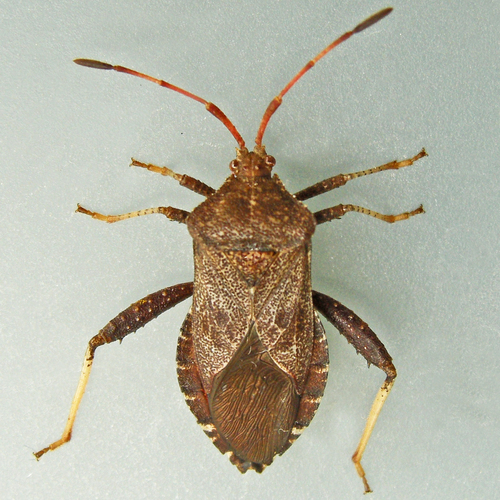
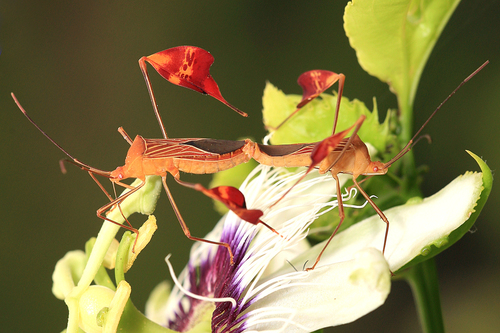
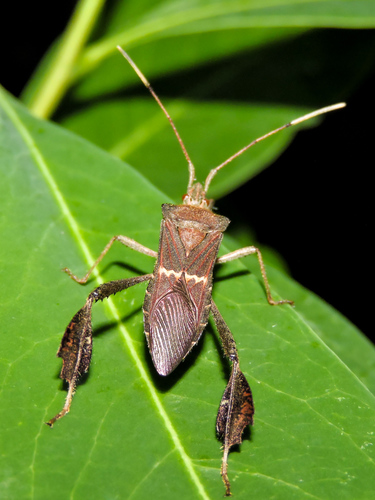
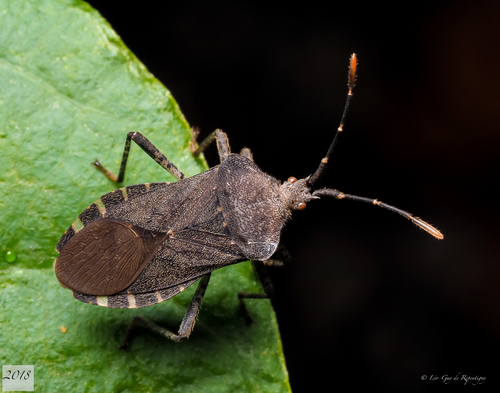
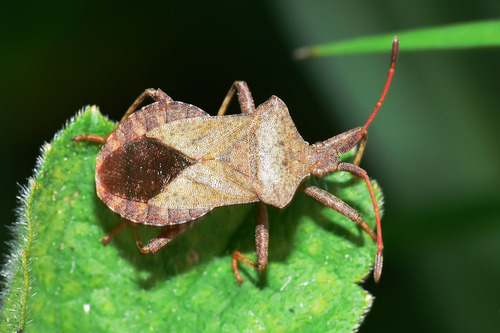
This species is commonly known as the dock bug, with the scientific name Coreus marginatus (Linnaeus, 1758). For adult dock bugs, the head, pronotum, and abdomen are speckled reddish brown. Their antennae are made of four segments, colored red-orange except for the final fourth segment, which is black. Between the antennae sit two small projections called antenniferous tubercles, a trait that distinguishes this species from other superficially similar species. The pronotum has angular upward-facing projections, and the scutellum is clearly visible. The rounded edge of the abdomen bears lighter-colored markings. Adults measure between 13 and 15 millimeters (0.51 and 0.59 inches) long; males are typically smaller than females, but have longer antennae. Young nymphs differ in appearance from adults. They are heavily spined, have less uniform coloration, and have disproportionately large antennae relative to their body size. Older nymphs look more similar to adults, with more uniform speckled brown coloration, but lack developed wings. Like other members of the Coreidae family, Coreus marginatus has scent glands with small pores in the middle of its thorax. These glands can release strong-smelling, irritating, volatile defensive chemicals when the insect is disturbed. The pores have an ultrastructure made of mushroom-like structures connected to each other via ridges and trabeculae. The chemical composition of scent gland secretions is similar between males and females, though the relative proportions of the compounds differ. In females, the most common chemical compound is hexanoic acid, while in males it is stearic acid. Linnaeus originally described this species from Europe; only one of his original specimens has a specific recorded locality, which is England. Other early specimens collected by Goeze come from France. Its current extensive distribution covers Europe from Portugal to Finland; Asia from Russia to China; and Africa, where it is only known from Algeria. Like other Coreidae, the dock bug has an annual life cycle. After hatching from an egg, it goes through five successive nymphal instars before reaching adulthood. It overwinters in the adult stage, then mates in the typical back-to-back position used by heteropterans. Females lay large brown eggs between late May and early July. Eggs take around 3 to 4 weeks to hatch. Young nymphs feed on leaves and stems, while older nymphs and adults feed on seeds. Nymphs mature into adults starting from August onwards.