About Corella eumyota Traustedt, 1882
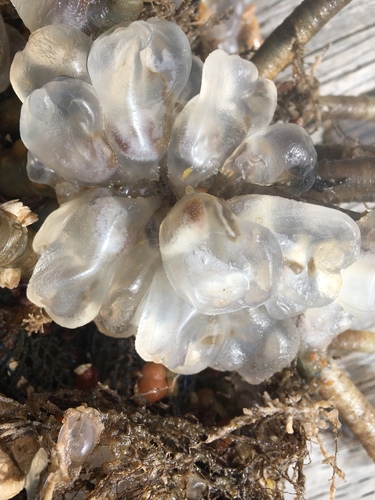
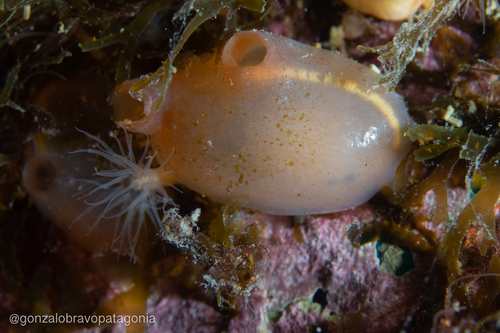
Corella eumyota is a species of tunicate (sea squirt) first formally described by Traustedt in 1882. In its native southern hemisphere range, it can reach a length of about 24 cm (9 in), and is coloured grey or ivory. The tunics of large individuals are thin, transparent and papery; smaller, much more abundant individuals have thicker, gelatinous tunics. This species has been introduced to the northern hemisphere, where individuals grow to 2 to 4 cm (0.8 to 1.6 in) long, are semitransparent, and come in white, brown, or orangeish colouration, with siphons that are often orange. C. eumyota normally lies recumbent on its right side and is roughly oval in shape, but it fits its body to the contours of its surrounding substrate. Its inhalent siphon is located at the tip of the body, while the exhalent siphon sits a third of the way down the body's right side. Neither siphon can be retracted. While the tunic is often clean, it may sometimes be covered by a biotic film, or overgrown by other members of this species or other tunicate species. The hind gut is visible through the tunic and forms a simple curve, a feature that distinguishes it from the similar Molgula spp. (sea grapes) found in European waters, which have an S-shaped hind gut. Corella eumyota is native to the waters surrounding Antarctica, as well as to southern coastal waters of South America, South Africa, Australia, and New Zealand. It has a wide distribution across the Antarctic continental shelf, occurring at depths between 30 and 842 m (98 and 2,762 ft). After being introduced to the northern hemisphere, it is now found in northwestern Europe, specifically in Spain, France, Ireland, and along the south coast of England. C. eumyota is a suspension feeder: it creates a current to draw water in through the inhalent siphon, filters out food particles, then expels the filtered water through the exhalent siphon. It feeds largely on organic particles stirred up from the seabed sediment. In its native Antarctic waters, this is a slow-growing, long-lived species. It spawns during the austral summer. Larvae are retained inside the adult's body cavity until they are well-developed; when released, they settle onto the seabed within a few minutes. Because of this limited dispersal distance, groups of C. eumyota grow quite close to one another.