About Cordyline australis (G.Forst.) Endl.
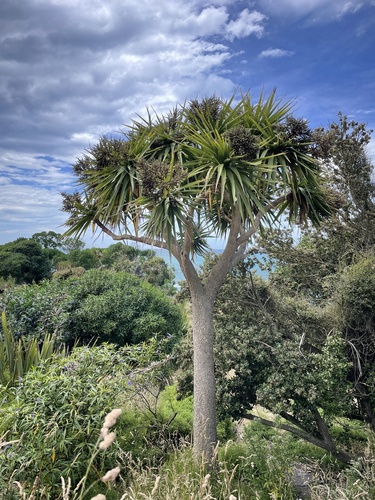
Cordyline australis (G.Forst.) Endl. typically grows up to 20 metres (66 feet) tall, with a stout trunk 1.5 to 2 m (4 ft 11 in to 6 ft 7 in) in diameter. The largest recorded specimen, growing at Pākawau, Golden Bay / Mohua, was estimated to be 400 to 500 years old. It stood 17 metres (56 feet) tall with a 9-metre (30-foot) circumference at its base. Before flowering, this species produces a slender, unbranched stem. First flowering most commonly occurs when the plant is 6 to 10 years old, in spring. Under favorable conditions, first flowering can occur as early as 3 years of age, as observed in Havelock North during the 2015 mast flowering year. After first flowering, the stem divides to form a heavily branched crown, with dense tufts of leaves growing at the tips of each branch. Each branch may fork again after producing a flowering stem. The bark is pale to dark grey, corky, persistent, fissured, and has a spongy texture when touched. The leaves are long, narrow, sword-shaped, and erect, ranging from dark to light green in color. They measure 40 to 100 cm (16 to 39 in) long, and 3 to 7 cm (1 to 3 in) wide at the base, with numerous parallel veins. Leaves grow in dense clusters at branch tips; older leaves may droop slightly at the tips and bend downward from their bases. Leaves are thick, with an indistinct midrib. Their fine veins are roughly equal in size and run parallel to each other, and the upper and lower leaf surfaces look identical. Sweetly scented flowers are produced in spring and early summer, arranged in large, dense panicles (flower spikes) 60 to 100 cm (24 to 39 in) long. Flowers are arranged along the panicle's ultimate branches; they are spaced from well-separated to somewhat crowded, and are almost sessile to fully sessile. Bracts that protect developing buds often have a distinct pink tinge before flowers open, though bracts are green in populations from south Canterbury and North Otago. Individual flowers are 5 to 6 mm (3⁄16 to 1⁄4 in) in diameter, with tepals that are free almost to their base and reflexed. Stamens are roughly the same length as the tepals, and stigmas are short and trifid. The fruit is a white berry 5 to 7 mm (3⁄16 to 9⁄32 in) in diameter, which is avidly eaten by birds. Flowers have a strong sweet scent, and their nectar attracts large numbers of insects. Mature plants produce large, peg-like rhizomes covered in soft purplish bark that can grow up to 3 metres (10 feet) long vertically downward below ground. These rhizomes anchor the plant and store fructose in the form of fructan. Young rhizomes are mostly fleshy, made up of thin-walled storage cells, and grow from a layer called the secondary thickening meristem. As botanist Philip Simpson summarized, Cordyline australis (commonly called cabbage tree) occupied a wide range of habitats in early New Zealand, and its abundance and distinctive shape strongly shaped how visiting travelers perceived the New Zealand landscape. Simpson stated: "In primeval New Zealand cabbage trees occupied a range of habitats, anywhere open, moist, fertile and warm enough for them to establish and mature: with forest; around the rocky coast; in lowland swamps, around the lakes and along the lower rivers; and perched on isolated rocks. Approaching the land from the sea would have reminded a Polynesian traveller of home, and for a European traveller, conjured up images of the tropical Pacific". The natural range of C. australis extends from North Cape to the far south of New Zealand's South Island, where it becomes increasingly rare until it reaches its southernmost natural limit at Sandy Point (46° 30' S), west of Invercargill near Oreti Beach. It is absent from most of Fiordland, likely due to a lack of suitable habitat, and has never been recorded on New Zealand's southern subantarctic islands, probably because conditions are too cold. It grows on some offshore islands including the Poor Knights Islands, Stewart Island, and the Chatham Islands, but it was probably introduced to these locations by Māori. In the Stewart Island region, it is rare, growing only on specific islands, headlands, and former settlement sites where it may have been introduced by muttonbird collectors, while it is largely a notable absentee across most of the Chatham Islands. C. australis is generally a lowland species, growing from sea level up to approximately 1,000 metres (3,300 feet). It reaches its highest elevation on the volcanoes of the central North Island, where volcanic eruptions have created open growing space, and in the foothills of the Southern Alps in the South Island, where deforestation may have helped create room for it to grow. In the central North Island, C. australis has evolved a much sturdier growth form, known to Māori as tī manu, meaning "with branches bearing broad, straight upright leaves". This form is similar to that found in the far south of the South Island, suggesting both are adaptations to cold conditions. C. australis is a light-demanding pioneer species, and seedlings die if they are overtopped and shaded out by other trees. Young plants require open space to grow well, and also require access to water during the seedling stage. While mature trees can store water and are drought-resistant, seedlings need a consistent water supply to survive. This prevents the species from growing on sand dunes unless wet depressions are present, and from growing on hillsides unless a seepage area is available. Soil fertility is another important factor: early settlers in Canterbury used the presence of C. australis to select locations for their homesteads and gardens. Fallen cabbage tree leaves also increase soil fertility as they decompose. Temperature, particularly frost severity, is also a limiting factor. Young trees are killed by frost, and even mature trees can be damaged and die back from heavy frost. This is why C. australis is absent from upland areas and very frosty inland regions. Early European explorers of New Zealand reported "jungles of cabbage trees" along stream and river banks, in enormous swamps, and in lowland valleys. Very few examples of this former widespread abundance survive today, as these flat, fertile lowland areas were the first to be cleared by early farmers. In modern New Zealand, cabbage trees most often grow as isolated individuals rather than as components of intact, healthy ecosystems. The cabbage tree's annual growth cycle begins in autumn, with a tight spike of unopened leaves emerging from the center of each leaf tuft. Some growing tips switch from producing leaves to developing inflorescences for the coming spring, and two or three leaf buds begin growing leaves around these developing inflorescences. Both the inflorescence and leaf buds overwinter protected by the surrounding spike of closed unopened leaves. Months later, in spring or early summer, flowers open on the outside of the tree, exposed to pollinating insects and birds. Flowering occurs over four to six weeks, to maximize exposure to pollinating insects. Flowers produce a sweet scent that attracts large numbers of insects. The nectar contains aromatic compounds, mostly esters and terpenes, that are especially attractive to moths. Bees use this nectar to produce a light honey, which they use to feed their young and expand their hive size in early summer. Fruit takes around two months to ripen, and by the end of summer a single cabbage tree can produce thousands of small fruits that are eaten and dispersed by birds. The strong rigid structure of the inflorescence can easily support the weight of large birds like the New Zealand pigeon, which was historically the main seed disperser for this species. Each fruit contains three to six shiny black seeds coated in a charcoal-like substance called phytomelan, which may protect seeds during passage through a bird's digestive tract. Seeds are also high in linoleic acid, which acts as a food source for the developing embryo, and is also an important nutrient in the egg-laying cycle of birds. Since it takes approximately two years for a given stem to produce an inflorescence, cabbage trees tend to flower heavily in alternate years, with a major bumper flowering event every three to five years. A single inflorescence bears 5,000 to 10,000 flowers, so a large inflorescence can hold around 40,000 seeds. A whole tree can produce one million seeds in a good flowering year, and a healthy grove can produce hundreds of millions of seeds in a bumper year. In traditional Māori culture, there was extensive detailed knowledge of the cabbage tree covering spiritual, ecological, and many practical uses. While much of this specialized knowledge was lost after European settlement of New Zealand, use of the tree for food and medicine persists, and use of its fibers for weaving is becoming more common again. The stems and fleshy rhizomes of C. australis are high in natural sugars. They were traditionally steam-cooked in large earth ovens called umu tī, a type of hāngī, to produce kāuru, a carbohydrate-rich food used to sweeten other dishes. The growing tips or leaf hearts, stripped of their outer leaves, were eaten raw or cooked as a vegetable; these are called kōuka, which is the origin of the tree's Māori name. The southern limit of traditional kūmara (sweet potato) cultivation in New Zealand was at Banks Peninsula at 43°S, and south of this line a local food culture developed around harvesting C. australis from both natural and planted groves. Large groups of harvesters trimmed cut stems and left them to dry for days or weeks. Along with stems, rhizomes — large carrot-shaped extensions of the trunk growing below ground — were also dug up for cooking. In the early 1840s, Edward Shortland reported that Māori preferred rhizomes harvested from trees growing in deep, rich soil. Rhizomes were dug in spring or early summer just before flowering, when their sugar content was highest. November was the preferred month for preparing kāuru in the South Island. After drying, harvested stems and rhizomes were steamed for 24 hours or longer in the umu tī pit. Steaming converts the carbohydrate fructan in the plant material to sweet fructose. Cooked stems or rhizomes were then flattened by beating and transported back to villages for storage. Kāuru could be stored dry until it was added to fern root and other foods to improve their flavor. The sugar in the stems or rhizomes partially crystallizes, forming a sugary pulp mixed with other material between the root fibers, which are easily separated by tearing. Kāuru could also be dipped in water and chewed, and was described as smelling and tasting similar to molasses. Remains of large umu tī cooking pits can still be found in the hills of South Canterbury and North Otago, where large cabbage tree groves remain standing. Early Europeans used the plant to make alcohol, and the often potent brews were popular with whalers and sealers. The growing tip of the plant, called kōata, was eaten raw as medicine. When cooked, it is called kōuka. If the spike of unopened leaves and a few outer leaves is gripped firmly at the base and bent, it snaps clean off. Removing the leaves leaves a structure similar to a small artichoke heart, which can be steamed, roasted, or boiled to make kōuka, a bitter vegetable available year-round. Kōuka is commonly used as a relish for fatty foods such as eel, muttonbirds, or pigeon, and in modern times for pork, mutton, and beef. Individual trees are selected for bitterness: strong bitterness is preferred for medicinal use, while milder bitterness is desired when the kōuka is used as a vegetable. In traditional Māori rongoā medicinal practices, various parts of Cordyline australis were used to treat injuries and illnesses, prepared either as a boiled drink or a pounded paste. The kōata growing tip was eaten raw as a blood tonic and cleanser. Leaf juice was used to treat cuts, skin cracks, and sores. A leaf infusion was taken internally to treat diarrhoea, and used externally as a bath for cuts. Leaves were rubbed until soft and applied directly or as an ointment to cuts, skin cracks, and cracked or sore hands. Nursing mothers ate young shoots, and young shoots were also given to children to treat colic. Liquid from boiled shoots was taken to treat other types of stomach pain. The seeds of Cordyline australis are high in linoleic acid, one of the essential fatty acids. Cordyline australis was the first native New Zealand plant used by early European settlers to produce liquor. In the 1850s, distiller Owen McShane created a liquor from C. australis rhizomes, sold under the names Cooper's Schnapps or McShane's Chained Lightning, which he sold to settlers and Māori in the lower South Island. Other early European uses included woven hats for settlers, and toboggans for children. Today, Cordyline australis is one of the most widely cultivated native New Zealand trees. It is very popular as an ornamental tree in Northwest Europe and other cool oceanic climates, because it looks similar to a palm tree. Hardy forms from the coldest areas of the southern or inland South Island tolerate Northern Hemisphere conditions best, while North Island forms are much less cold-hardy. It can also be grown successfully in Mediterranean climates. It is easy to grow from fresh seed, and seedlings often appear spontaneously in gardens from bird-dispersed seed. It can also be easily propagated from shoot, stem, and even trunk cuttings, and grows well in pots and tubs. It can be grown as far north as the eastern coast of Scotland, including the village of Portgower. It is more common in Southern England and across Ireland, where it is grown throughout the island. Although it is not a true palm, it is considered a pseudo-palm, and is locally called the Cornish palm, Manx palm, or Torbay palm. The last name comes from its extensive planting in Torbay, where it is the official symbol of the area and used in tourist posters promoting South Devon as the English Riviera. Even though its natural distribution ranges from 34° S to 46°S, and it has ultimately subtropical origins, it also grows around five degrees from the Arctic Circle in Masfjorden Municipality, Norway (latitude 61ºN), in a microclimate protected from arctic winds and warmed by the Gulf Stream.