About Cordyceps militaris (L.) Fr.
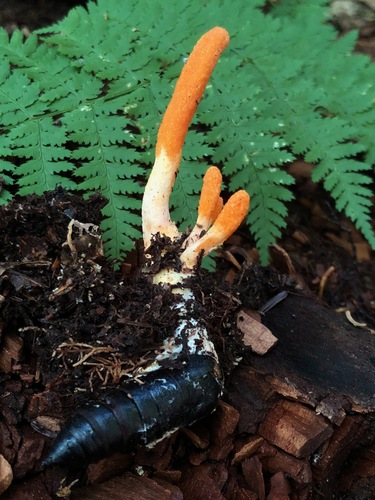
Cordyceps militaris (L.) Fr. produces club-shaped, orange to red fruiting bodies that are 1 to 8 centimeters (1⁄2 to 3+1⁄4 inches) tall, and grow out of dead underground pupae. The entire club is covered by a stroma, into which the actual reproductive fruit structures, called perithecia, are embedded. The outer surface of the fruiting body has a roughly pitted appearance, while the inner fungal tissue ranges from whitish to pale orange. Many mycological authors consider C. militaris to be quite common and widespread across the Northern Hemisphere; in Europe, its fruiting bodies develop from August to November. North American field guides generally classify C. militaris as inedible or "probably edible". In Asia, the fruiting body is cooked and used as an ingredient in dishes such as chicken soup, pork bone soup, and hot pot. It has been approved as a novel food in China. It is commonly sold as a dietary supplement that is claimed to offer various health benefits, but there is not sufficient scientific evidence to confirm its safety or effectiveness. Product quality can also vary widely because of inconsistent processing and labeling practices. Most health claims for this species exist because it is similar to Ophiocordyceps sinensis, which also has unproven health effects. C. militaris can be cultivated using multiple different growth media, including silkworm pupae, rice, and liquid nutrient solutions. It is grown commercially in China, Vietnam, Taiwan, and Indonesia. Cultivated C. militaris crops can be damaged by pathogenic molds, which parasitize and kill the fungus.