About Cordia sebestena L.
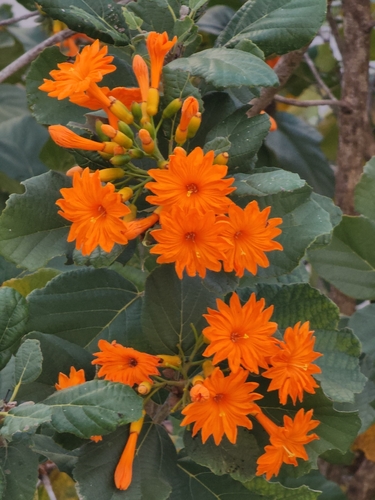
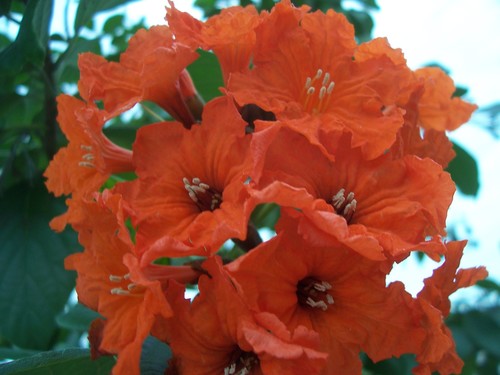
At maturity, Cordia sebestena L. reaches a maximum height of 8–9 m (25–30 ft), with a spread of nearly the same size as its height. Its crown ranges from round to vase-shaped. Branches are typically somewhat drooping, and the tree naturally grows with multiple trunks. If only one trunk is allowed to develop, it can reach a diameter of 30 cm (12 in). Its dense evergreen foliage is made up of dark green, leathery, alternate, ovate leaves that grow up to 18 cm (7 in) long, with wavy margins. All leaves are covered in small hairs, giving them a rough, sandpapery texture. Flowers grow in clusters at the ends of branches year-round, with the most abundant blooming in spring and summer. Each flower is 5 cm (2 in) wide, red-orange, tubular, salverform (flaring outward), with 5–7 lobes and 5–7 stamens that are all a similar height. This species is heterostylous and is presumed to be self-incompatible. After flowering, the tree produces pear-shaped fruits that average 5 cm (2 in) in length. The fruits are fragrant and edible, but do not have a strong pleasant flavor. Cordia sebestena is widely planted across tropical regions as an ornamental garden plant, valued for its showy flowers. It grows slowly, and drops enough leaves and fruit to need regular maintenance. While its wood has a fairly low density, its branches do not break easily. Young trees should be pruned to establish a strong structure, because the species naturally tends to form branches low on the trunk. It can tolerate a fairly broad range of soil types, as long as the soil drains well. It withstands drought, but cannot survive frost. It is not especially vulnerable to most pests and diseases; only the geiger tortoise beetle causes occasional defoliation. It can tolerate salt spray from the ocean, grows best in full sun, and can also grow successfully in partial sun. Common uses for Cordia sebestena include planting as a street tree, a shade tree, and a container plant when it is young. It is also planted in traffic medians and parking lots, and works well for seaside landscaping.