About Cordia lutea Lam.
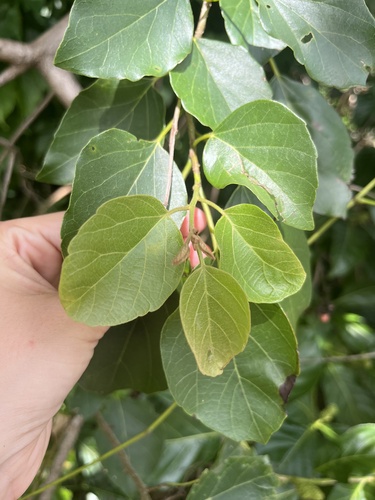
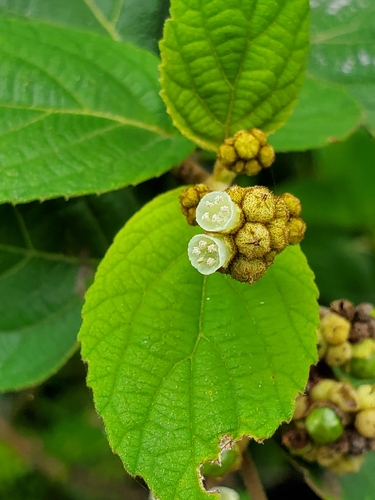
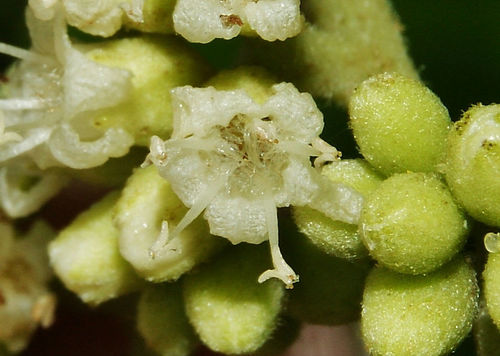
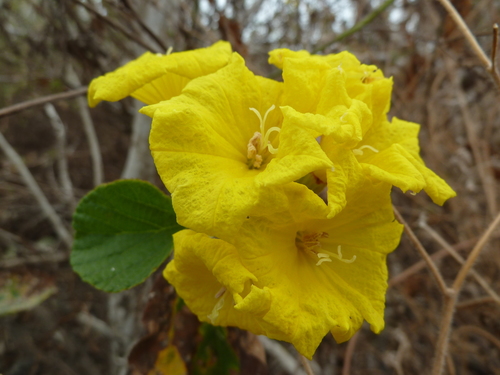
Cordia lutea Lam. grows as a shrub or small tree, reaching up to 8 m (26 ft) in height. Its young branches have a hairy covering. The undivided leaves are arranged alternately along branches, measure 4–10 cm (1.6–3.9 in) long, have an ovate to round shape, and bear very finely toothed margins. The upper surface of the leaf is rough in texture and hairless, while the lower leaf surface is covered in hairs. The species produces yellow, sweetly scented flowers arranged in cymes. The petals of each individual flower are fused together to form a trumpet shape, 2–4 cm (0.8–1.6 in) across at the open mouth, which has between five and eight lobes. Five to eight stamens are located inside the flower. After fertilization, a globular white drupe fruit forms, measuring 8–12 millimetres (0.3–0.5 in) across, and containing between one and four seeds. When first opened, the fleshy pulp of the fruit is slimy, and it becomes sticky after exposure to air. Cordia lutea is native to western mainland Ecuador, the Galápagos Islands, Peru, and the Marquesas Islands of Polynesia. It grows in arid regions. In the Galápagos, it occurs in lowland areas, often near the sea. In the Galápagos, the leaves of this species are mined by the moth Bucculatrix cordiaella.