About Corbicula fluminea (O.F.Müller, 1774)
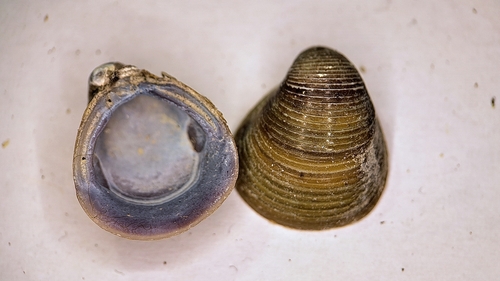
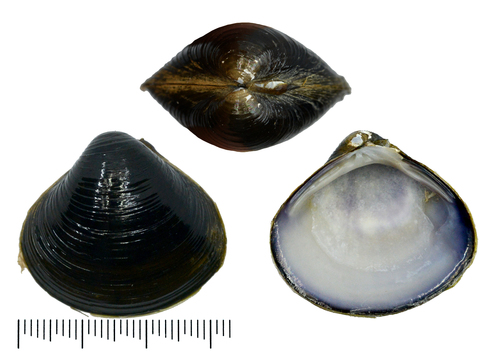
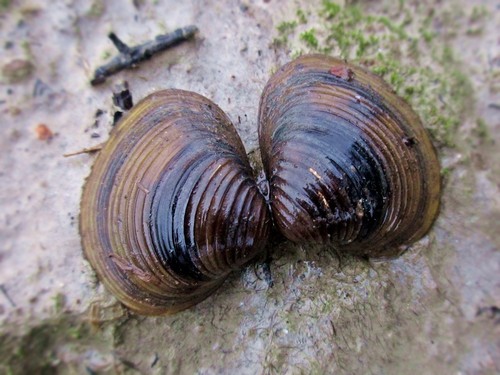
Corbicula fluminea is a species of freshwater clam. It is native to freshwater environments in eastern Asia—including Russia, Thailand, Cambodia, the Philippines, China, Taiwan, Korea, and Japan—and also naturally occurs in African freshwater environments. It has become a widespread, successful invasive species across the globe, with established populations in North America, South America, Europe, and New Zealand. This species has a range of common names: in Western regions, it is most often called the Asian clam, Asiatic clam, or Asian gold clam; in Southeast Asia, it is known as the golden clam, prosperity clam, pygmy clam, or good luck clam; and in New Zealand, it is commonly called the freshwater gold clam.
Studies have found inconsistent results on which abiotic habitat characteristics have the strongest link to the abundance of Asian clam populations. In Brazilian habitats, invasive Corbicula spp. reach their highest abundances in areas dominated by coarser sediment, and abundance is negatively correlated with increasing organic matter levels. Other research found that a combination of abiotic factors—water redox potential, inorganic nutrient content, water hardness, and organic matter content paired with the volume of very coarse sand—explains 59.3% of the variation in Corbicula population habitat association in statistical tests. Invasions by Asian clams appear to be limited by elevation (88% of their invaded range falls below 500 m elevation), latitude (90% of their invaded range lies between 30° and 55° latitude), and the ecosystem's minimum winter temperature, which has a limiting threshold of −10 °C (14 °F). One population was identified in Puerto Rico in 2001, from a specimen originally collected in 1998 at 18° latitude.
As adults, Corbicula fluminea are self-fertile simultaneous hermaphrodites. Immediately after reaching maturity, individuals start producing eggs and then sperm. An individual can broadcast spawn up to 570 mucoid larvae per day, and more than 68,000 larvae per year throughout its adult life. When larvae are released from the adult, they are approximately 200 microns in length. They disperse through water until they develop into sessile adults. Fully grown adults can reach a maximum length of about 5 centimetres (2.0 in).