About Corapipo altera Hellmayr, 1906
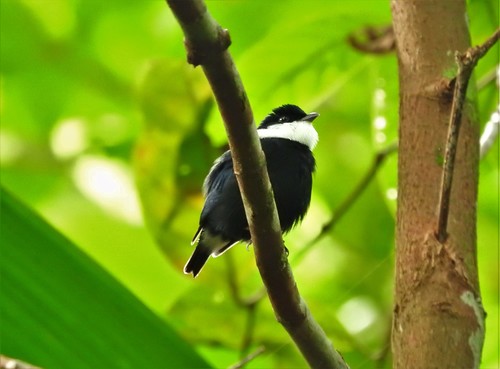
Corapipo altera, commonly known as the white-ruffed manakin, is a compact short-tailed bird, sharing this body shape with its manakin relatives. It has a flat, wide bill, dark legs, and striking male plumage. This species typically reaches 10 cm in length, with an average weight of around 11 g, ranging from 9 to 14 g; males are smaller than females. Adult males are mostly glossy blue-black, with a white erectile ruff covering the throat and sides of the neck. Their wings are modified to have a very short outer primary feather. Females and first-year birds are olive-green with a greyish throat. In their second year, males molt into mostly green plumage that includes a black mask and a partial white ruff. They only develop full adult plumage after the breeding season in their third year. This bird is common in the foothills and middle elevations of Central America. It breeds mainly between 400 and 600 m elevation on the Caribbean slope, and up to 1500 m elevation on the Pacific slopes. Some of its populations are partial altitudinal migrants, meaning some individuals move to lower elevations during the wet non-breeding season. It is a species associated with wet forest, and is mainly restricted to primary forest, but it sometimes occupies adjacent clearings and tall secondary growth. The white-ruffed manakin feeds low in tree canopies, eating fruit along with some spiders and insects; all food items are plucked directly from foliage while the bird is in flight. Males are highly frugivorous, with over 90% of their diet made up of fruit. Females increase the proportion of arthropods in their diet during the breeding season. A large share of the species' diet is made up of small berries from plants in the Melastomataceae family. White-ruffed manakins forage alone, or sometimes form loose groups in breeding areas, particularly bands of young males. They are more solitary in the lowlands, though they may join tanagers and other bird species in mixed-species feeding flocks. Molt takes place on the species' breeding grounds. Young males initiate molt as early as July, followed by reproductive-aged males that are 4th year or older, and then females. At the population level, molt can be relatively protracted, lasting through October. In populations that practice altitudinal migration, downhill movements happen during or right after heavy multi-day rainstorms, starting as early as July and continuing through the second half of the year. Once birds arrive at lower-elevation non-breeding areas, they stay there until they migrate uphill again in February. Males are more likely to make this altitudinal migration than females.