About Corallus caninus (Linnaeus, 1758)
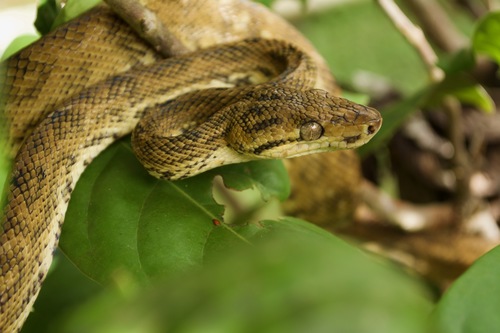
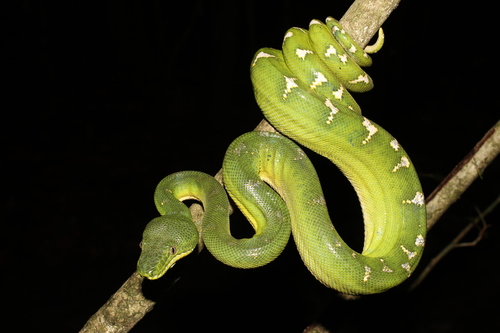
Adult Corallus caninus (emerald tree boas) typically reach about 6 feet (1.8 m) in length. They have highly developed front teeth that are proportionately larger than those of any other non-venomous snake. Their typical color pattern has an emerald green base color, with an irregular, interrupted white zigzag stripe (often called 'lightning bolts') running down the back, and a yellow belly. This bright, distinct patterning sets them apart from other South American snakes. Juveniles show a range of light to dark orange or brick-red colors before undergoing ontogenetic color change, turning full emerald green between 9 and 12 months of age. This same ontogenetic color shift also occurs in the green tree python Morelia viridis, where hatchlings and juveniles can also be canary yellow or brick-red. Contrary to common belief, Corallus caninus does not have yellow juvenile individuals like the green tree python. Some herpetologists have debated whether a locality-based morphological variant of this snake should be classified as a separate species, and the recently proposed name for this variant is Corallus batesii [Henderson]. Specimens from the Amazon River basin tend to be the largest, growing 7–9 feet (2.1–2.7 m) long, and are much more docile than northern populations; the overall average size of the species remains closer to 6 feet (1.8 m). Specimens from the southern end of the species' range in Peru tend to be darker in color. Amazon Basin specimens usually have an uninterrupted white dorsal line, while white markings on specimens from Guyana and Surinam (called "Guyana Shield" or "Northern" emerald tree boas) are quite variable. Amazon Basin specimens also have much smaller snout scales than northern, southern, and western populations found in locations including Suriname, Venezuela, Bolivia, and French Guiana. Hybrids between the Northern Shield Corallus caninus and the Amazon Basin variant are known to exist. The emerald tree boa looks very similar to the southern green tree python (Morelia viridis), which is native to Southeast Asia and Australia. This similarity is an example of convergent evolution, as the two species are only very distantly related. They can be distinguished by physical differences in head scalation and the placement of heat pits around the mouth. The species is found in northern South America, in northern Colombia, northern Brazil, and across the area from Venezuela to Suriname and the Guianas, within the Guiana Shield. The original type locality is recorded only as "Americae." The Amazon Basin variant, as its name suggests, is found only along the Amazon River basin, in southern Suriname, southern Guiana, southern Venezuela extending to Colombia, Peru, and Brazil, in the surrounding jungles of the Amazon River. The emerald tree boa is ovoviviparous. Females produce an average of 6 to 14 young per litter, and larger litters are extremely rare. Newly born juveniles have a characteristic brick-red to orange coloration, and gradually complete their ontogenetic color change over 12 months to become fully emerald green.