About Coracopsis vasa (Shaw, 1812)
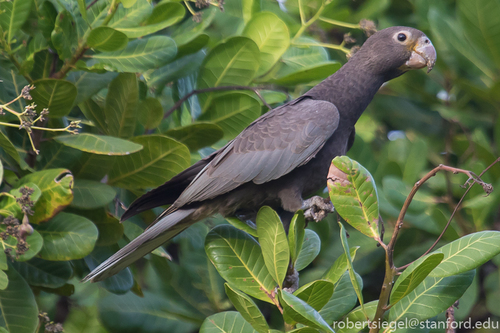
The greater vasa parrot, Coracopsis vasa (Shaw, 1812), has an uncertain breeding season that is most likely between October and December. This species has a very unusual breeding biology and mating system: females are 25% larger than males and are physically dominant. Greater vasa parrots live in loose, polygynandrous groups, where each female has at least 3 to 8 sexual partners. Males of this species have re-evolved a phallus, and copulations can last up to 90 minutes. Copulations occur in two length categories: short, lasting 1 to 3 seconds, and long, with an average duration of 36 minutes. Long copulations involve a copulatory tie, a trait most commonly seen in mammals such as canids and felids. During a copulatory tie, the male and female cannot physically separate during mating, caused by swelling and the internal structure of the penis within the female’s body—this structure may be barbed or lined with small hooks in some species. During brooding and chick-rearing, females shed their head feathers and develop bright orange skin. They also sing complex songs from perches close to their nests. These behaviors attract males, who approach and regurgitate food that the female accepts while she is off the nest. During this period, females also defend a territory around their nest against other females. In Madagascar, the greater vasa parrot is more common in areas of dry deciduous forest. This differs from the closely related lesser vasa parrot, which is more common in the humid forests along Madagascar’s east coast. Greater vasa parrots feed in large, noisy flocks. Their diet includes wild berries, fruits, nuts, seeds, and cultivated crops such as maize, millet, and rice. These parrots are active on moonlit nights; at other times, they roost in large noisy flocks in the canopies of large trees. One individual in the flock acts as a lookout to warn other group members of danger. Greater vasa parrots held at Lincolnshire Wildlife Park have been recorded using grinding technology, marking the first time this behavior has been observed in a non-human animal. The birds were observed holding date stones and pebbles in their beak to grind calcium-rich dust from seashells. This grinding behavior occurs most frequently just before the breeding season, and males were observed performing it more often than females. A possible explanation for this pattern is that females need extra calcium to build eggshells, and males provide this calcium to females via regurgitated food.