About Coracina papuensis (Gmelin, 1788)
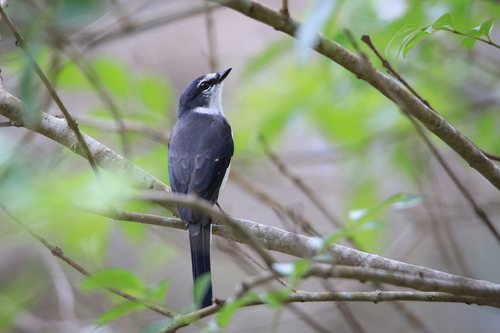
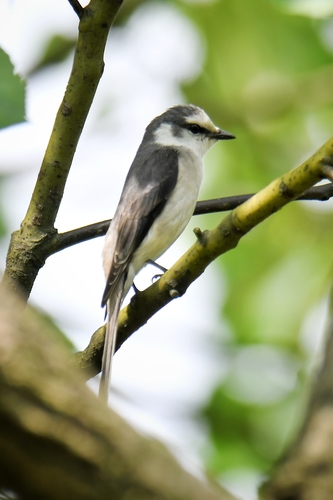
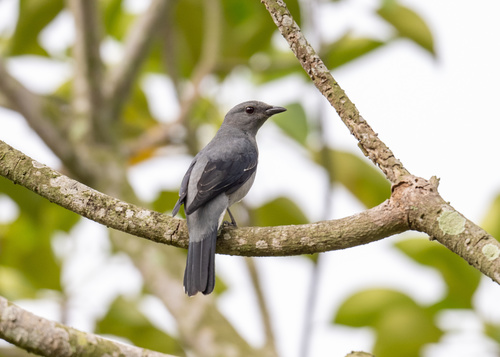
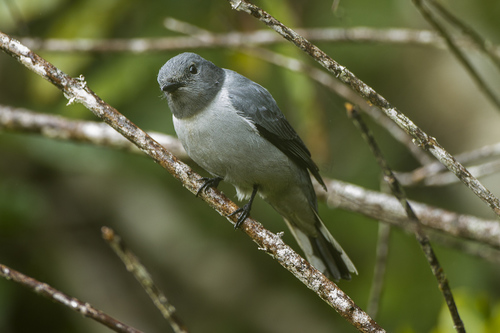
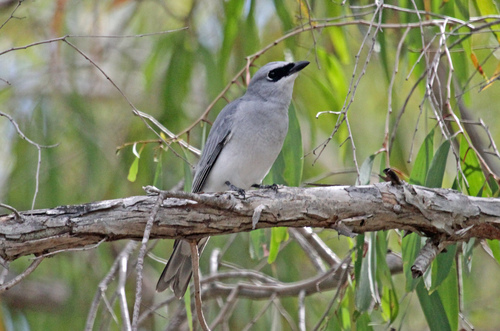
This species, the white-bellied cuckooshrike, has a short black mask that extends from its beak through the lores to the eyes, and does not reach past the eyes, along with a fine white rear eye-ring. Its head, upperparts including upper wings are pale blue-grey, while its tail feathers lean toward darker grey. Despite its common name, its belly ranges from white to grey, depending on the region and subspecies. The subspecies Coracina papuensis robusta may have a dark morph, with extensive black plumage on the neck and chest that often shows barring along the edges. There is almost no visible variation between adult males and females. Immature birds can have lightly barred underparts, a duller overall appearance than adults, and a less distinct black mask. This species is often confused with the black-faced cuckooshrike due to similar markings, but it is smaller with a more compact body. An adult white-bellied cuckooshrike reaches 22 to 29 cm in length, and weighs between 55 and 80 grams. It has a characteristic call, described as a peevish kissik kissik or quiseek. It also produces a weak, squealing, slurred, repeated whee-eeyu or wee-year that has been compared to the call of a parrot in the Psittacidae family. This cuckooshrike is often noticed while flying thanks to its distinct undulating flight pattern: it gains altitude by flapping its wings, then holds its wings stiffly downward to glide. The white-bellied cuckooshrike’s range covers parts of Australia, Indonesia, Papua New Guinea, and the Solomon Islands. In Australia, it occurs across tropical northern Australia and eastern Australia, including the northern regions of Western Australia, the Northern Territory, Queensland, New South Wales, Victoria, and southeast South Australia. It is common across Papua New Guinea and the Solomon Islands, and less common in Indonesia. In Indonesia, it is most often found in the northern Moluccas, and occurs occasionally in Eastern Wallacea. It adapts well to a wide variety of habitats and vegetation types, including savanna, woodlands, Eucalyptus forests, riparian forest, rainforest, littoral forest, river redgum bushland, mangroves, open grasslands, coconut plantations, farmlands, and suburban gardens. It generally prefers lower-lying forested habitats, mostly found below 800 meters above sea level. Most populations are predominantly sedentary or locally nomadic, although the subspecies C. p. robusta is considered migratory.