About Coracina maxima (Rüppell, 1839)
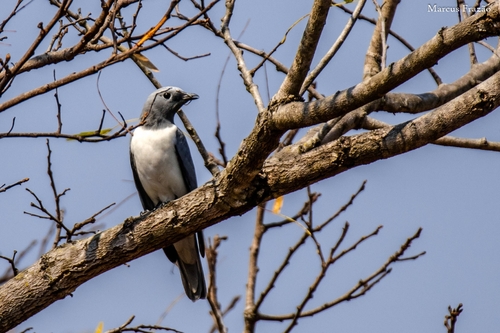
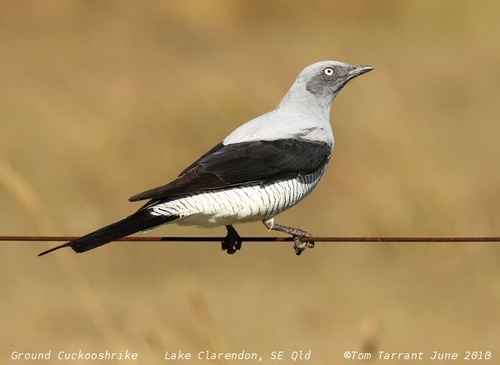
The ground cuckoo-shrike, with the scientific name Coracina maxima (Rüppell, 1839), is a slender, long-legged bird. It is the largest cuckoo-shrike, measuring 33–37 cm in length and weighing approximately 115 g. It received the common name cuckoo-shrike not because it is related to cuckoos or shrikes, but because it shares similar features with both groups: it has a stout, hooked shrike-like beak, and plumage that resembles that of a cuckoo. Adult ground cuckoo-shrikes have a pale grey head and upper body, and pale yellow eyes. Their lower back, rump, and underparts are white with fine black barring, which contrasts with their black wings and slightly forked black tail. The slightly forked tail is a unique characteristic of this species. Immature ground cuckoo-shrikes have a similar overall appearance to adults, but have fine, broken black barring on the throat and upper parts, and dark eyes with a dark eye-line, instead of the adult’s pale yellow eyes and black mask. The species’ flight call is distinctive, sounding like pee-ew, pee-ew or chill-chill….kee-lik, keelick. Because of the species’ coloration, ground cuckoo-shrikes can appear black-and-white in flight, and are sometimes mistaken for Australian magpies. The ground cuckoo-shrike is widely distributed across Australia, occurring mainly in Queensland, New South Wales, South Australia, Western Australia, the Northern Territory, and the Australian Capital Territory, with some populations found in parts of Victoria. Most populations are found inland of the Great Dividing Range in Australia’s semi-arid regions, though the species also occurs in areas along the east coast. It inhabits open woodland, arid shrubland, and open grasslands dominated by dead trees and plant species including mulga, cypress-pine, and mallee-spinifex. Ground cuckoo-shrikes are most likely to occupy these habitats when they are located near watercourses, floodplains, creeks, and wetlands. Because of this habitat preference, the species is seen more often in inland areas than in coastal regions. It has been recorded in woodland along river channels and floodplains, mulga shrubland, and regrowth areas in cleared woodland. Despite having a large range across Australia, the ground cuckoo-shrike is an uncommon species with a thin, scattered distribution. It is probably nomadic, which makes it difficult to predict where individuals can be seen. Its current population trend is decreasing; this decline may have been driven by reductions in the species’ population in the Murray-Mallee region starting in the mid-1970s. Dolby and Clarke (2014) clearly list and describe locations where ground cuckoo-shrikes can be expected to be spotted.