About Coracias spatulatus Trimen, 1880
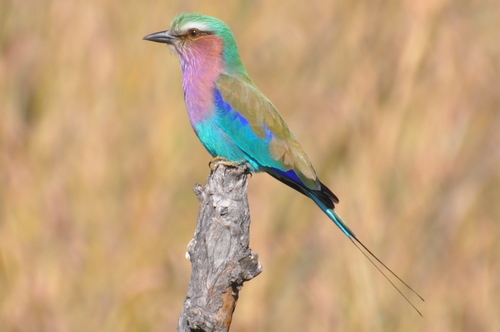
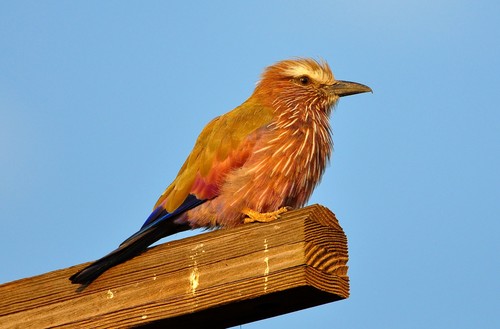
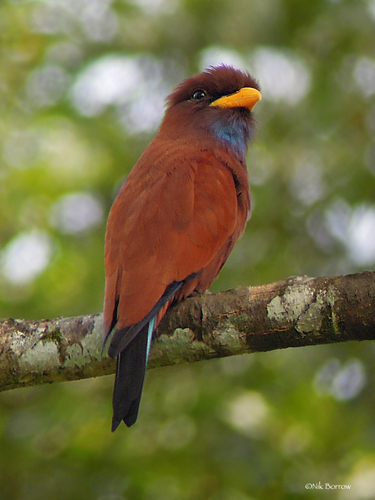
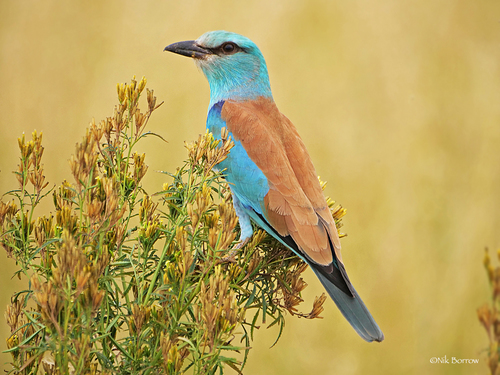
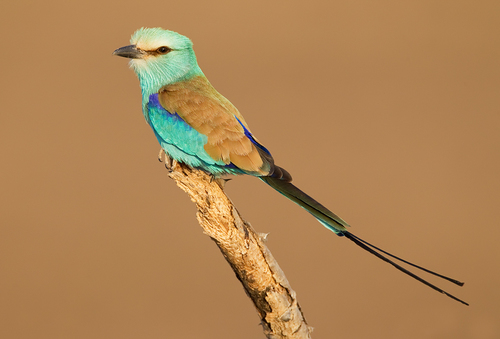
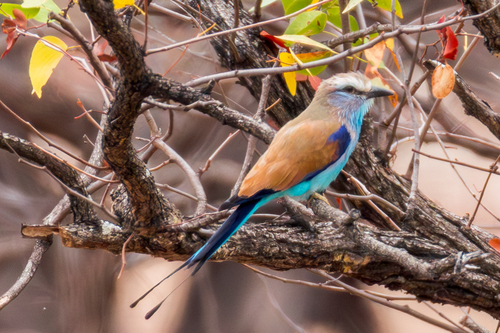
The racket-tailed roller (scientific name Coracias spatulatus Trimen, 1880) gets its common name from the prominent elongated outer tail feathers, which have long streamers ending in paddle-shaped tips. This bird measures 28 to 30 cm (11 to 12 inches) in length, with the tail streamers extending an additional 8 cm (3 inches). Its forehead and superciliary streak are white, the crown is dull green, the back is rufous, and the tail is blue. Its underparts are pale blue marked with whitish streaks. When in flight, a purple upper wing with an azure-blue stripe is visible; the under wing is pale blue with a purplish-black trailing edge and tip. This species resembles the European roller (Coracias garrulus) and the lilac-breasted roller (Coracias caudatus), but those two species do not have the distinctive tail streamers of the racket-tailed roller. It has a black beak, brownish eyes, and dull yellowish legs. Juvenile birds are similar in appearance to adults but have less vivid plumage, and lack the elongated, narrowed tail feathers. Its call is a harsh guttural shriek, given when the bird swoops downward. Like other members of the genus Coracias, this species hunts for prey from a perch in the mid-storey of woodland. When it spots edible prey on the forest floor, it swoops down to capture it. Its diet is made up primarily of grasshoppers, beetles, insect larvae, scorpions, and small lizards. The racket-tailed roller is usually solitary or found in pairs, though it may form small groups of six or seven individuals. It is a territorial species, and drives away intruders by rocketing down from a height with a raucous screech, rolling from side to side as it levels off, then using its momentum to return to a perch. It nests in a cavity in a tree trunk or branch roughly 7 m (23 ft) above the ground, and often uses an abandoned nest originally made by a woodpecker or barbet. The clutch of eggs is laid in the unlined cavity and usually contains three or four eggs. Overall, little is known about this species' nesting habits.