About Coracias garrulus Linnaeus, 1758
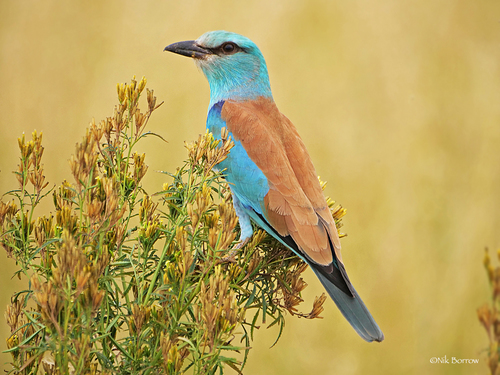
The European roller (scientific name: Coracias garrulus Linnaeus, 1758) is a stocky bird matching the size of a Eurasian jay, with a total length of 29–32 cm (11–13 in) and a wingspan of 52–58 cm (20–23 in). It is mainly blue with an orange-brown back. Its strong, direct flight is very distinctive, with brilliant blue plumage that contrasts sharply with black flight feathers. Males and females look similar, while juvenile birds are a duller version of adults. The species' courtship display involves twists and turns similar to a lapwing's display, and these maneuvers give the bird its English common name. Its call is a harsh crow-like sound, and it produces a raucous series of calls when it feels nervous.
The European roller occupies warmer regions. The nominate subspecies breeds in northern Africa from Morocco to Tunisia, in southern and east-central Europe, and extends east through northwestern Iran to southwestern Siberia. Subspecies C. g. semenowi breeds from Iraq and southern Iran, east through Kashmir and southern Kazakhstan to Xinjiang. The species' European range was once more extensive, but it has seen long-term population decline in the north and west, and it is now extinct as a breeding bird in Sweden and Germany. It is a long-distance migrant that winters in Africa south of the Sahara across two separate regions: one spanning from Senegal east to Cameroon, and another from Ethiopia west to Congo, extending south to South Africa, with observations of the bird recorded in the Degua Tembien mountains. Some populations migrate to Africa by passing through India. One case of a collision between a European roller and an aircraft over the Arabian Sea has been recorded.
This species lives in warm, dry, open country with scattered trees, and prefers lowlands. It occurs at elevations up to 1,000 m (3,300 ft) in Europe, and up to 2,000 m (6,600 ft) in Morocco. Open oak and pine woodlands are its prime breeding habitat, but it also uses farms, orchards, and other similar areas with mixed vegetation. In Africa, it uses a similarly wide range of dry, open land with trees. It winters primarily in dry, wooded savanna and bushy plains, and typically nests in tree holes. In behavior and ecology, European roller chicks will vomit a foul-smelling orange liquid onto themselves to deter predators. This odor also warns parent birds when they return to the nest.
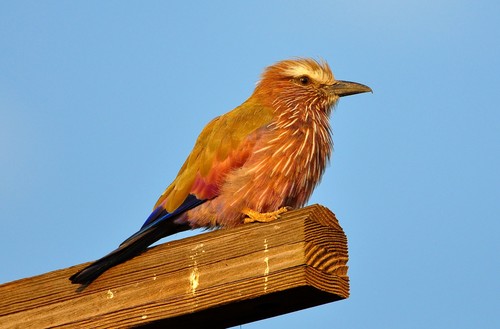
When feeding, European rollers often perch prominently on trees, posts, or overhead wires, just like giant shrikes, while watching for their prey: large insects, small reptiles, rodents, and frogs. The diet of adult European rollers is dominated by beetles, while nestlings mostly eat Orthoptera, such as grasshoppers and bush crickets.