About Coracias caudatus Linnaeus, 1766
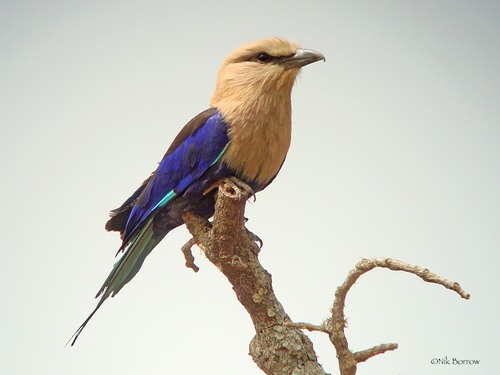
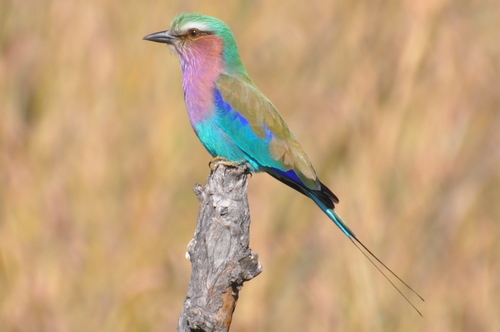
In field observation, these robust, large-headed birds often perch alone on a tree in a grassy clearing, and their colorful plumage makes them almost unmistakable. For the nominate subspecies Coracias caudatus caudatus, the lilac throat deepens into a darker lilac breast; the area from the crown to the mantle is olive, and the cheeks and ear coverts are lilac-rufous. For subspecies C. c. lorti, the crown to mantle is greenish blue rather than olive, the breast is azure, the throat is lilac, and some lilac-throated rollers of this subspecies have a lilac patch or rufous-brown tinges on the lower abdomen. Both subspecies have long, black outermost tail streamers, which are absent in juvenile birds. Lilac-breasted rollers are not sexually dimorphic, though males may be slightly larger than females. Juveniles, immature birds, and adult individuals all have the largest alula feather colored dark blue, while the primary coverts and the rest of the alula are azure. The proximal half of the remiges is also a brilliant azure; the distal half is black on the inner web, and dark purple blue on the outer webs. Juveniles have rufous-tawny throats and breasts marked with broad diffuse buffy-white streaks, and some feathers have mauve margins. Immature birds have buffy breasts with occasional lilac feathers and diffuse pale streaking. The average mass of this species is 104 grams, total body length ranges from 36 to 38 centimeters, which includes a tail streamer measuring 8 to 9 cm. These acrobatic fliers have an average wingspan ranging from 50 to 58 cm. Syndactyl feet, where the second and third digits are fused, are a unique trait of rollers, the family Coraciidae that this species belongs to. In the Turkana Basin of Kenya, lilac-breasted rollers may be confused with the sleeker Abyssinian roller; the Abyssinian roller can be distinguished by its dark blue upper tail coverts, azure breast, and distinctly spatulate tail streamers. Apart from having spatulate tail streamers, pinkish-breasted racket-tailed rollers have darker greater coverts and darker blue primary coverts. Lilac-breasted rollers are found across eastern and southern Africa, occurring locally from sea level up to 2,000 metres above sea level or higher. Their range extends from the Red Sea coast of Eritrea through East Africa, including Zanzibar, to southern Africa, where they are common in Namibia (excluding the Namib Desert), Botswana, Zimbabwe, and northeastern South Africa. The nominate subspecies C. c. caudatus is non-migratory, but does undergo some post-breeding dispersal into miombo woodland or sandy areas, before returning to breeding areas at the start of the rains. The other subspecies, C. c. lorti (also called the lilac-throated roller), migrates from northeast Kenya to northwest Somalia to breed from late April to mid-September. This subspecies is also recorded as a vagrant in Eritrea, Oman and Yemen. Lilac-breasted rollers are most abundant in Kenya, though the species is less abundant now than it was in the past. Both subspecies inhabit open savannah habitats with scattered trees and shrubs, as these birds need elevated perches for feeding and nesting. Less frequently, they live in riverine vegetation and open light forest, and may enter subdesert steppe or open grassland if any elevated perches are available there. In protected areas, lilac-breasted rollers are one of the bird species that regularly visit road verges, especially during fires, when small animals and insects emerging from cover are easy to prey on. However, lilac-breasted rollers avoid other human-influenced areas and are not found in urban or populated rural areas unless those areas are abandoned. Outside of protected areas such as national parks, lilac-breasted rollers may be seen infrequently when farmers burn land for agricultural use. These brush fires stir up insects and other invertebrates, and the birds can be seen swooping in to catch this easy prey.