About Coracias benghalensis (Linnaeus, 1758)
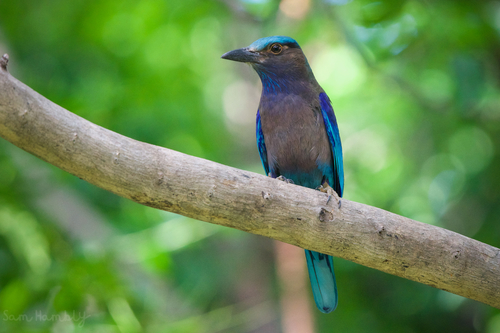
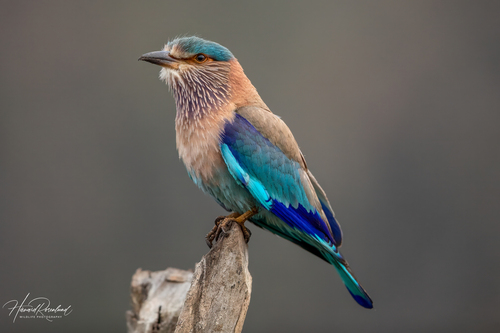
The Indian roller (Coracias benghalensis (Linnaeus, 1758)) is a bulky, broad-winged bird with a large head, short neck, and short legs. Its body measures 30–34 cm (12–13 in) in length, has a 65–74 cm (26–29 in) wingspan, and weighs 166–176 g (5.9–6.2 oz). Bare skin around its eyes is dull orange; its legs and feet are yellow-brown, the base of its bill has a brown tinge, and its iris is grey-brown. This species ranges from Iraq and the United Arab Emirates across the Indian subcontinent, including Sri Lanka. In Pakistan, it is a resident species found in wetlands around Chotiari Dam (Sindh), Jiwani Coastal Wetland (Balochistan), and along the Tonsa Barrage and Chenab River in Punjab. It has been recorded as a summer visitor to Jalalabad in northeastern Afghanistan, and as a vagrant in Syria, Saudi Arabia, Masirah Island, Qatar, Yemen, Socotra, Bahrain (where it was sighted in 1996 and 2008), the Lakshadweep islands, the Maldive Islands, and Turkey. In Kuwait, it is a common winter visitor on Green Island and farmlands near Al Jahra. In the 1970s, it was reported to be a common winter visitor in the marshes and mudflats of Shadegan County, Iran, though the species is currently listed as resident in Iran. The Indian roller is a common species, most often found in open woodland dominated by trees of the genera Acacia and Prosopis, and has adapted well to human-modified landscapes including parks, gardens, fields, and date and coconut palm plantations. In northern Oman, pairs that live in vegetation on roundabouts have earned the species the nickname "roundabout bird"; in the country, it is common in the Al Batinah Region and in cultivated areas east of the Sharqiya Sands at elevations below 1,000 m (3,300 ft). In India, it has been sighted at elevations from sea level in the Bhitarkanika Mangroves and the Gulf of Mannar up to around 2,100 m (6,900 ft) in the Nilgiri Mountains. The Indian roller is not very gregarious, and is usually found alone or in pairs. It is often territorial, though migrating individuals may forage in flocks without displaying aggression. They patrol their territory flying at treetop or three-story height, and when an intruder is spotted, they chase it away with a fast rolling flight. Its migration patterns are not well understood; in Oman, individuals are present year-round but appear to be more common in winter than in summer. After spending a few minutes preening, the Indian roller flies around its roosting site. It favours electric or telegraph wires as perches. It also perches in trees and shrubs 3–9 m (10–30 ft) high, from which it flies down to forage for ground insects; it also uses higher perches in the upper tree canopy. Its courtship display is an aerobatic sequence of twists and turns. This bird is attracted to wildfires, and darts into hot smoke to pursue insects. It has also been observed following tractors to feed on disturbed invertebrates. In southern Indian agricultural habitats, it occurs at a density of around 50 birds per km2. When nesting, Indian rollers act aggressively towards potential predators, driving Indian jungle crows (Corvus culminatus) away from nests. They have even been recorded repeatedly divebombing an Egyptian vulture (Neophron percnopterus), and flying at humans. Blood parasites Haemoproteus coraciae live inside the Indian roller's red blood cells, and Leucocytozoon blood parasites have been recorded in its lung tissues. Parasitic helminth worms Hadjelia srivastavai, Cyrnea graphophasiani, Habronema thapari, and Synhimantus spiralis have been recorded from the gizzards of Indian rollers. The Indian roller descends to the ground to catch insects, and less commonly eats amphibians, reptiles, other birds, and small mammals. It is attracted to swarms of winged termites; as many as 40 birds have been seen perching on a 70 m (230 ft) stretch of electric wire to hunt these swarms. Beetles make up approximately 45% of its diet, followed by grasshoppers and crickets which make up around 25%. The Indian roller often associates with the great Indian bustard (Ardeotis nigriceps), catching insects that are flushed out by the bustard. In Tamil Nadu, it has been observed to forage mainly by gleaning (catching prey from a surface), followed by feeding on the ground and in the air. It occasionally dives into water to catch frogs and fish, similarly to a kingfisher. It will take advantage of opportunities like insects attracted to artificial lights, and will feed even late after dusk. In March 2019, an Indian roller was observed feeding on an Indian wolf snake (Lycodon aulicus) in Sathyamangalam Wildlife Sanctuary.