About Coptodon zillii (Gervais, 1848)
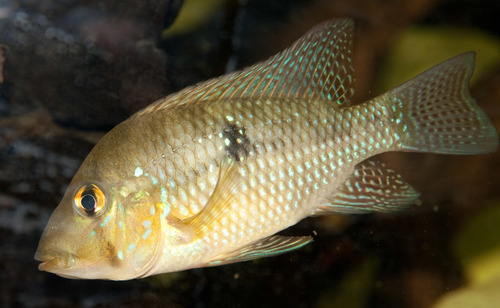
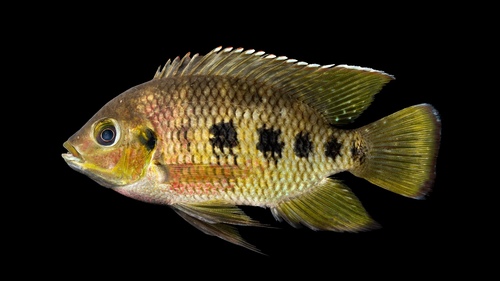
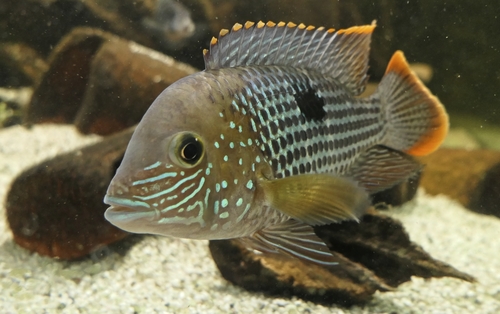
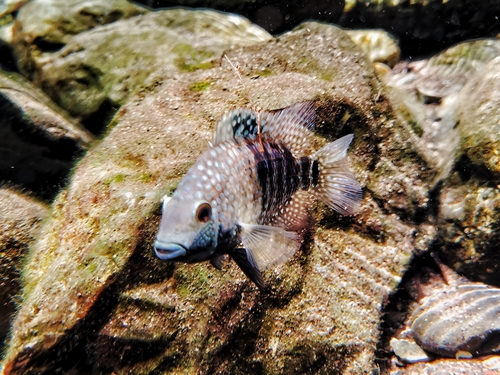
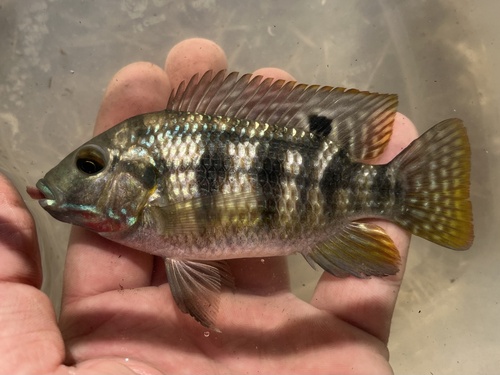
The redbelly tilapia, with the scientific name Coptodon zillii (synonym Tilapia zillii), is also called Zille's redbreast tilapia or St. Peter's fish, a name shared with other tilapia species found in Israel. It is a cichlid fish species. The species was originally described by Paul Gervais in 1848, and he named it in honor of M. Zill, a distinguished naturalist who collected and sent the type specimen to Gervais. Redbelly tilapia are naturally widespread in fresh and brackish waters across the northern half of Africa and the Middle East. They have been introduced to other regions of Africa, as well as Asia, Australia, and North America, both as a food fish and to control aquatic vegetation. In introduced areas, it sometimes becomes invasive, threatening local ecologies and native species. It is an important food fish and is sometimes raised in aquaculture. Across its native African range, redbelly tilapia have an almost continuous distribution from coastal southern Morocco and the Senegal River in tropical West Africa to the central Congo River basin in Central Africa. In northeastern Africa, the species occurs across most of the Nile basin, from the Nile delta in northern Egypt to Lake Albert on the border of the Democratic Republic of the Congo and Uganda, as well as Lake Turkana on the border of Ethiopia and Kenya. It is not native to the other African Great Lakes, though it has been introduced to some of these lakes. In the Maghreb and Sahara, where suitable aquatic habitats are scarce, the species' range is much more fragmented, but several relict populations persist in seasonal rivers, lakes, and oasis gueltas. Outside Africa, the species' natural range is restricted to the Jordan River system (including Lake Tiberias, also called Kinneret) in Israel, Jordan, and Syria, as well as coastal water systems in Israel. While Africa has a very large diversity of cichlids, redbelly tilapia is one of only a few cichlid species present in parts of its range. In the Maghreb and Sahara, excluding the species-rich Nile, the only other cichlids are the blue tilapia (Oreochromis aureus), mango tilapia (Sarotherodon galilaeus), and a small number of Astatotilapia and Hemichromis species. In Western Asia, the only other native cichlids are a few oreochromine tilapia species and the Jordan mouthbrooder (Astatotilapia flaviijosephi). Genetic studies confirm that most redbelly tilapia populations are very closely related, but a handful of populations from the outer edges of the species' range have uncertain taxonomic status and require further study. A population from the Kisangani region is closely related but appears to be a separate lineage. Similarly, populations from coastal northwestern Africa are genetically quite distinct from other redbelly tilapia populations. In the Nile system, populations from the Nile delta, northern White Nile, and lakes near Fayum differ from one another in morphology and coloration, but it is unclear if these differences are taxonomically significant. The virtually unknown C. ismailiaensis from northeastern Egypt may only be an aberrant redbelly tilapia; it differs primarily in having an unspotted tail. Redbelly tilapia prefer shallow waters with vegetation, but they also occur in more open habitats such as sandy shores, and can be found at depths up to 30 meters (100 feet). While it is primarily a species of fresh and brackish water habitats, it can tolerate high salinities up to 4% (for comparison, seawater is approximately 3.5% salinity), though the maximum salinity where it will breed is 2.9%. It can also survive across a wide range of water temperatures. In the northern part of its native range, water temperatures sometimes drop below its minimum requirement of 6.5–13 °C (43.7–55.4 °F) (the exact minimum depends on multiple factors), leading to large-scale mortality. In Alabama, where the species was introduced, new individuals had to be released each year to maintain a population because all existing fish die over winter. The typical upper temperature limit for the species is 36 °C (97 °F), but it can survive temperatures as high as 42.5 °C (108.5 °F).