About Coptodon rendalli (Boulenger, 1897)
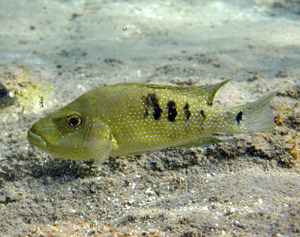
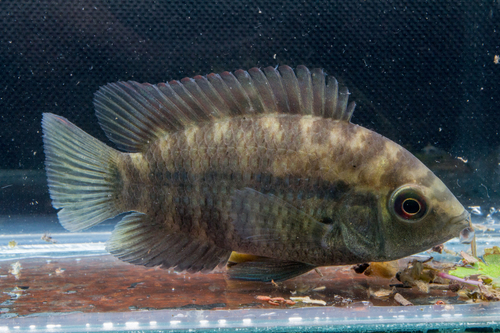
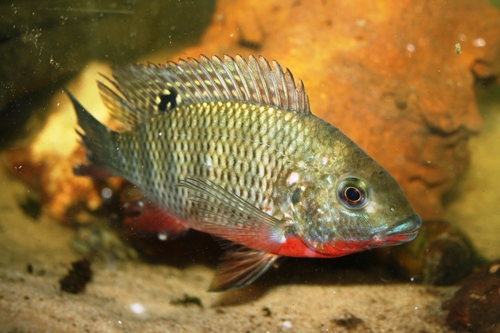
Coptodon rendalli reaches a maximum total length of 45 cm and a maximum weight of 2.5 kg, with a deep-bodied, laterally compressed profile. Body height makes up 42.2 to 49.4% of the fish's standard length, while head length accounts for 31.1 to 37.5% of standard length. The top of the head is convex; in large individuals, it may sometimes be concave due to continued growth of the mouth area. The mouth holds short, wide, thick, bicuspid teeth. The lower pharyngeal jaw is as wide as it is long, and its toothed posterior region is longer than its anterior region. There are 7 to 10 gill rakers on the lower arm of the first gill arch. The head and back are olive-green on the dorsal surface, and paler along the sides. Like all species in the genus Coptodon, the breast and belly are often colored with a red tint. A small number of lateral markings are present on the flanks. The dorsal fin is olive-green, with a red edge and white to grey spots on its soft-rayed portion. Fin counts for this species are: dorsal fin XIV–XVII/10–13, anal fin III/9–10. Scale counts are: 28–32 scales along the standard length, with 3–5 scale rows on the sides of the head. Coptodon rendalli has 29 vertebrae.
This species is distributed across the upper Congo River drainage basin, the Kasai River drainage basin, Lake Tanganyika, Lake Malawi, the Zambezi River, coastal areas from the mouth of the Zambezi to KwaZulu-Natal, the Limpopo River, the Okavango River, and the Cunene River. It has been established as an edible fish in several countries.