About Coptis trifolia (L.) Salisb.
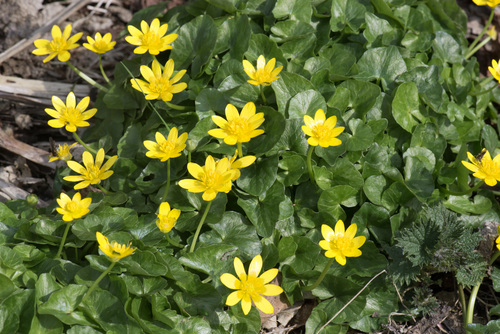
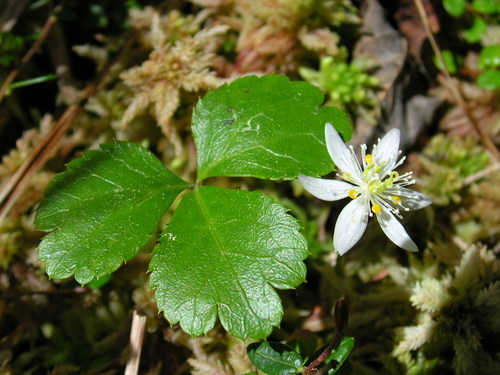
Coptis trifolia (L.) Salisb., commonly known as goldenthread, is a small perennial forb. It spreads via slender, bright golden-yellow creeping rhizomes, which gives the species its common name. Its evergreen leaves are roughly 2.5 cm (1.0 in) long and wide, divided into three leaflets, and grow from stems on petioles approximately 7.5 cm (3.0 in) long. Each leaflet is roughly fan-shaped with serrated margins, and has a shiny, dark green surface. Solitary flowers, around 1.3 cm (0.5 in) wide, grow from the ends of bare stalks that rise 3–17 cm (1.2–6.7 in) above the stem. Each flower has 5–7 white petal-like sepals that alternate with short, yellow, club-shaped petals. The bisexual flowers hold several bright green styles curled at the tips, surrounded by 30–60 white-tipped stamens. Fruits form a cluster of 4–7 erect follicles. Each fruit has a stipe that is equal to or longer than the 3.9–7 mm (0.15–0.28 in) long fruit body. Fruits are elliptical in shape, with a 2–4 mm (0.08–0.16 in) long beak. When mature, fruits dehisce to release several small seeds 1–1.5 mm (0.04–0.06 in) wide. This plant blooms between April and July depending on latitude, and fruits develop shortly after blooming.
Coptis trifolia is native to subarctic regions of North America and Asia, with a naturally fragmented range split into three broad population groups. The first group ranges from southern Greenland and Labrador west to Manitoba, and south to the mountains of North Carolina. The second is found in Alaska and adjacent areas of British Columbia, extending into eastern Siberia, Japan, and Manchuria. Records of the species from Norway and central Russia are most likely the result of misidentification. The species’ wide, disrupted range indicates the three populations have been isolated from each other for long periods of time. It grows in a broad range of wet to mesic habitats across its range, including coniferous and mixed forests, bogs, willow scrub, and tundra. It is often associated with mosses, and with Eastern hemlock where their ranges overlap.
In 1963, the fungus species Lambertella copticola, belonging to the genus Lambertella, was discovered growing on the dead leaves and petioles of Coptis trifolia. Fungi from the genus Gloeosporium can infect C. trifolia and other Coptis species, reducing the plant’s normal function. The slug Arion fasciatus also feeds on goldenthread. Coptis trifolia is not tolerant of disturbance, and often does not recover after logging, either from canopy loss or mechanical damage to its root system. It is also not well adapted to fire, due to its shallow roots, and grows in areas that typically have long fire rotations of up to 500 years. Because of its sensitivity to disturbance, C. trifolia is particularly vulnerable to damage from human development and recreation.
The rhizome of Coptis trifolia was used by multiple Native American peoples, including many Algonquian groups and the Haudenosaunee, to relieve canker sores and other mouth ailments. This use gave the species another common name: canker-root. A tea made from the plant has been used as an eyewash, as well as an anthelmintic, antiemetic, emetic, and gastrointestinal aid. Like the medicinal plant goldenseal, goldthread is used to treat symptoms of influenza and the common cold. Coptis trifolia has demonstrated biological activity against E. coli and Bacillus subtilis. Its active medicinal compounds are the alkaloids berberine and coptine.