About Copsychus mindanensis (Boddaert, 1783)
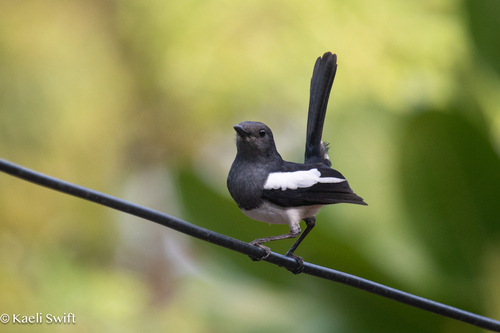
According to eBird, Copsychus mindanensis, the Philippine magpie-robin, is a common medium-sized bird found in open forest, scrub, and gardens, ranging from lowlands to middle mountain elevations. Males have black upperparts, throat, and chest, a white belly, and a prominent white marking on the wing. In females, all black areas except the black wing are replaced by gray. It is similar in size and color to the Philippine Pied-Fantail, but can be distinguished by its wing's white mark. Its primary song is a pleasant, medium-pitched warble. It also produces a short descending scratchy song, harsh rasping notes, or a pulsing, downslurred "chew! cew! chew!"
This species was first described by French polymath Georges-Louis Leclerc, Comte de Buffon in 1775 in his *Histoire Naturelle des Oiseaux*, from a specimen collected on Mindanao island in the Philippines. A hand-coloured engraved plate of the bird created by François-Nicolas Martinet appeared in *Planches Enluminées d'Histoire Naturelle*, produced under the supervision of Edme-Louis Daubenton to accompany Buffon's text. Neither Buffon's description nor the plate caption included a scientific name. In 1783, Dutch naturalist Pieter Boddaert coined the binomial name Turdus mindanensis in his catalogue of the Planches Enluminées. The Philippine magpie-robin is now one of 12 species in the genus Copsychus, which was introduced by German naturalist Johann Georg Wagler in 1827. It was formerly treated as a subspecies of the oriental magpie-robin (Copsychus saularis), but was elevated to full species status following the results of a 2009 molecular phylogenetic study. The species is monotypic. The genus name Copsychus derives from the Ancient Greek kopsukhos or kopsikhos, meaning "blackbird". The specific epithet mindanensis comes from Mindanao, the species' type locality. It differs from the Oriental magpie-robin by having a white belly, an all black tail, paler gray throat and breast in females, a smaller overall size particularly in the bill and wing, and also differs considerably in vocalization.
This species is extremely adaptable to nearly all habitats except montane forest. It occurs in lowland forest, second growth, agricultural areas, scrub, and parks. The IUCN has classified the species as Least Concern, as it is common across its wide range. Its ability to thrive in degraded habitat makes it one of the few endemic Philippine birds with a non-declining population.
There is little published data on the diet of this specific species. Its diet consists mostly of insects, small vertebrates, seeds, and fruit. It forages on the ground and in vegetation. Its breeding season runs from April to July. The nest is an untidy cup constructed from grass, roots, and fibres, placed in bamboo clumps, trunks, branches, and even on man-made structures. Clutch size is usually 2 eggs.