About Coprosma virescens Petrie
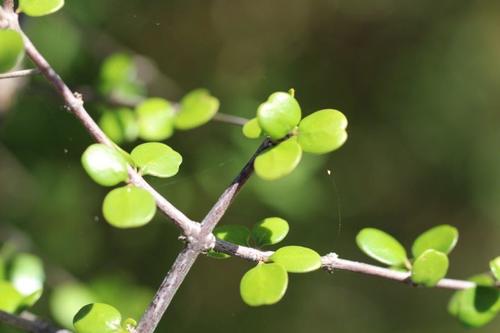
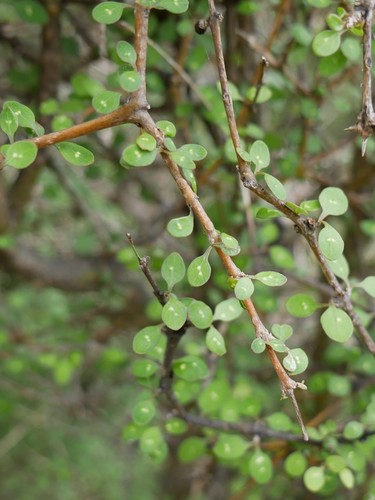
Coprosma virescens is an endemic New Zealand plant belonging to the genus Coprosma in the family Rubiaceae. In common New Zealand usage, its Māori name is mikimiki – this name is also used for several closely related species including C. dumosa, C. rhamnoides, C. propinqua, and C. crassifolia. This species is a small-leaved evergreen shrub or tree that reaches 2 to 3 metres (6 ft 7 in – 9 ft 10 in) in height. It produces very slender, more or less glabrous divaricating branches. Its small leaves are petiolate, with petioles measuring 2 to 5 millimetres (0.079–0.197 in) long. Leaves narrow suddenly at the petiole, and can grow up to 9 millimetres (0.35 in) long and 6 millimetres (0.24 in) wide, with wavy margins or a few blunt teeth. It grows throughout the South Island in lower montane forest and scrubland. Apetalous male flowers grow in axillary clusters of one to two on very short branches. Female flowers grow singly at the ends of short branchlets. The fruit is an oblong drupe, yellow to white in color, and up to 6 millimetres (0.24 in) long. However, ripe fruit appears greenish, because the green seeds inside are visible through the fruit tissue; this characteristic is the source of the species' specific name. It has a wide distribution across New Zealand's North and South Islands. In the North Island, it occurs from the Gisborne ranges and areas south of Taihape. In the South Island, it is common from Canterbury southwards, and extends to Southland. It does not grow in Westland, and is uncommon in other remaining regions of the South Island. Across most of its overall range, it is either uncommon or entirely absent. C. virescens is popular in cultivation, due to its tangled twiggy growth form and its ability to tolerate a wide range of soils and growing conditions.