About Coprophanaeus ensifer (Germar, 1821)
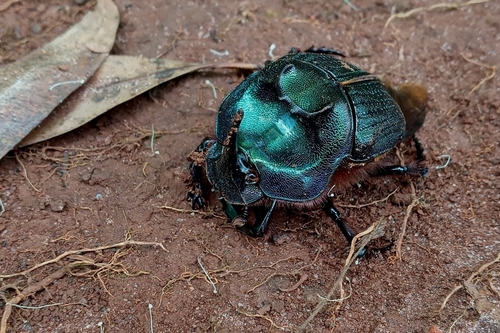
Description. Adult Coprophanaeus ensifer are typically 30–56 mm (1.2–2.2 in) long, and occasionally reach up to 65 mm (2.6 in). This makes C. ensifer and its close relative, the Amazonian C. lancifer, among the largest dung beetles in the world (along with species from the genera Catharsius and Heliocopris), and the largest dung beetles found in the Americas. This beetle has a horn on its head that is a similar size in both males and females. Its exoskeleton is usually dark metallic green, often with faint blue reflections, but it may occasionally be entirely metallic blue. Distribution and habitat. This species has a wide distribution across eastern, central and southern Brazil, far northeastern Argentina, eastern Bolivia and Paraguay, and occurs at elevations up to approximately 780 m (2,560 ft) above sea level. Most of the species’ range covers the Caatinga, Cerrado and similar open habitats, but in some regions its range also extends into the Atlantic forest and the Amazon rainforest. The related species C. lancifer is found in northern Brazil, and this limits the northern distribution of C. ensifer in these areas. It was previously believed that C. lancifer also occurred in the Juína region, but genetic analysis has shown that individuals in Juína are actually more closely related to C. ensifer. This finding indicates that the overall distribution of C. ensifer is larger than historically recognized. One study found that in Northeast Brazil, C. ensifer is more active during the rainy season, which coincides with lower local temperatures. This seasonal activity preference can be explained by the species’ large body size. During the high temperatures of the dry season, large-bodied C. ensifer struggle to maintain proper water balance, because a large volume of water can evaporate from their bodies. This large size-related water balance constraint also helps explain why these beetles are crepuscular, meaning they are most active at dawn and dusk.