About Coprinopsis variegata (Peck) Redhead, Vilgalys & Moncalvo
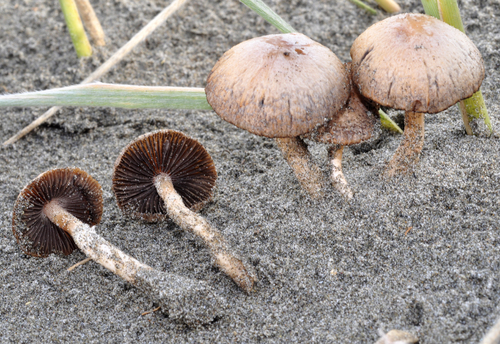
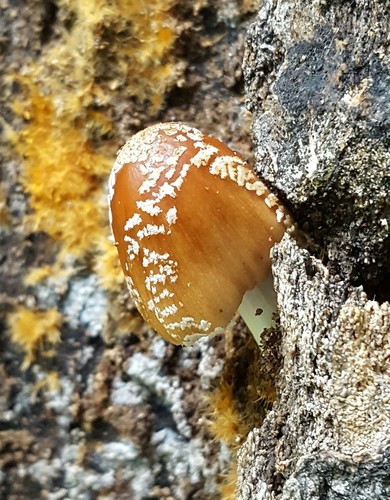
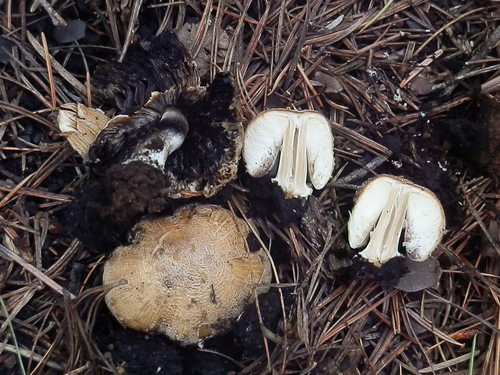
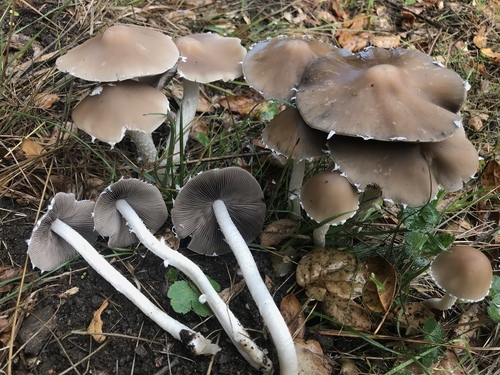
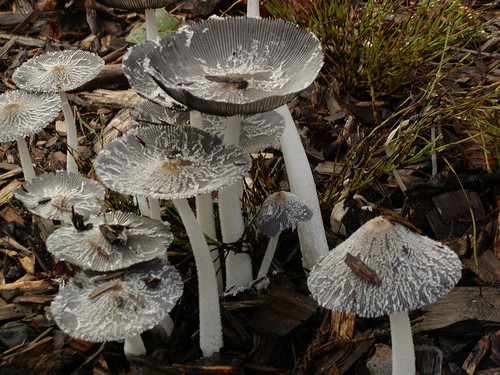
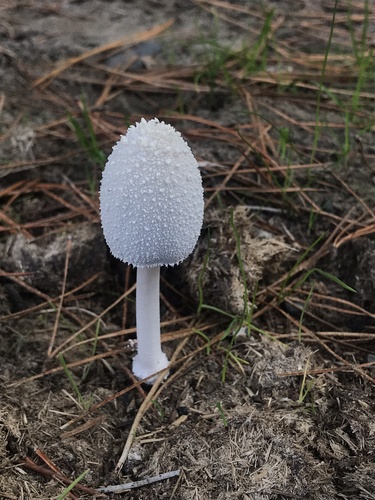
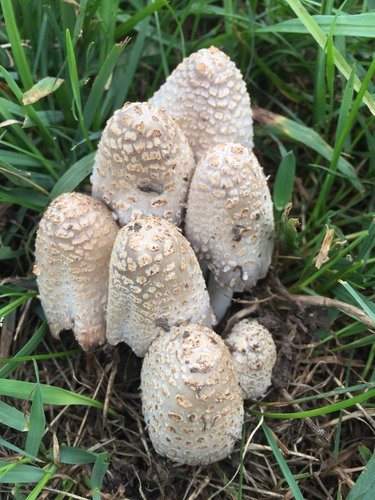
Coprinopsis variegata (Peck) Redhead, Vilgalys & Moncalvo has a thin cap that starts oval, becomes bell-shaped, then flattens with an upward-turned margin, reaching up to 12 inches (30.5 cm) in diameter. When young, the cap surface is covered by a woolly whitish or yellowish veil that breaks into short-lived flakes or scales, revealing a radially striate (grooved) gray to grayish-brown surface underneath. Its gills are broad, thin, closely crowded, and not attached to the stem. They start white and turn dark purplish-brown as spores mature. The stem measures 4 to 12 inches (10.2 to 30.5 cm) long and up to 1 cm (0.4 in) thick; it is hollow, whitish, roughly uniform in width along its length, and may have a wispy, cotton-like ring near its base. Clusters of fruit bodies have a mass of rhizomorphs at the base called an ozonium. Spore deposits are dark brown. Under a light microscope, spores are smooth, dark brown, ellipsoid when viewed from the face and egg-shaped when viewed from the side, with dimensions of 7.5–9.5 by 4–4.5 μm. The spore apex appears truncated due to the presence of a germ pore. Spore-bearing cells (basidia) are hyaline (translucent) and measure 14–16 by 6.5–7.5 μm. Paraphyses are 9–11 by 8–10 μm, hyaline, and collapse easily. Pleurocystidia (cystidia on the gill face) are abundant, roughly cylindrical, hyaline, and measure 100–150 by 20–35 μm. Cheilocystidia (cystidia on the gill edge) are present in young specimens, roughly ellipsoid, and measure 50–80 by 15–25 μm. Clamp connections are abundant in the hyphae of all fruit body tissues. This species is saprobic, getting nutrients by decomposing organic matter. It grows in clusters or groups on decaying leaf litter or well-decayed wood, and typically fruits only between June and July. This spring to early summer fruiting distinguishes it from the more common Coprinus comatus and Coprinopsis atramentaria, which fruit in late autumn. It is found in the United States east of the Great Plains. Coprinopsis variegata can attack soil bacteria including species of Pseudomonas and Agrobacterium, and use these bacteria as a nutrient source. It does this by growing specialized hyphae toward the bacteria, sensing them via a not yet fully understood chemoattractive mechanism. The fungus then secretes compounds to digest the bacteria, while growing assimilative hyphae to absorb the nutrients. The process is relatively rapid, and bacterial colonies can be fully assimilated in less than 24 hours.