About Coprinopsis lagopus (Fr.) Redhead, Vilgalys & Moncalvo
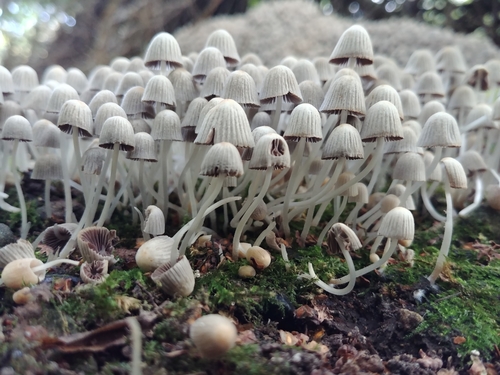
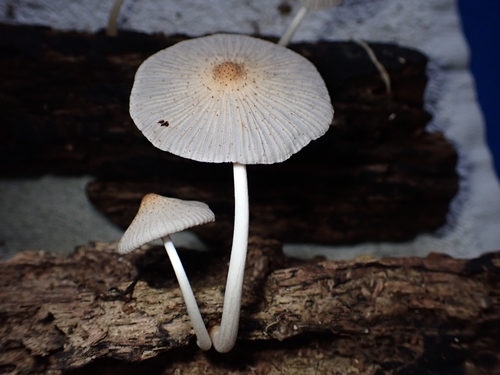
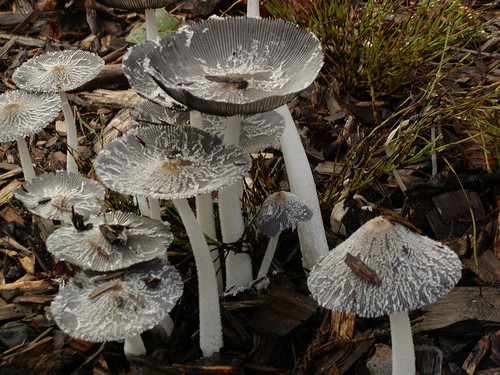
Fruit bodies of Coprinopsis lagopus vary tremendously in size. This fungus produces very small dwarf fruit bodies, some of which are less than 1/100 the size of the largest specimens. In a series of experiments growing spores on horse dung, Arthur Henry Reginald Buller documented this wide size range: the smallest specimen had a 1 mm long stem and 0.75 mm cap diameter, while the largest had an 18.4 cm (7+1⁄4 in) long stem and 2 cm cap diameter. Buller confirmed that dwarf fruit bodies are fully functional, producing and releasing spores exactly the same way as larger, normal-sized specimens. This extreme size variation has led some authors to incorrectly classify dwarf fruit bodies as new separate species. For example, George Edward Massee identified these dwarf fruit bodies as the new species Coprinus radiatus. Generally, dwarf fruit bodies have stems 1–10 mm tall and caps 0.75–3 mm in diameter. Large specimens have stems 5–18.5 cm (2–7+1⁄4 in) tall and 2–5 mm wide, with cap diameters of 2–5 cm (3⁄4–2 in). Larger specimens typically have stems 4–6 mm thick, with the club-shaped or bulbous base reaching up to 0.8 mm thick. Under the whitish to silvery grey veil, the cap surface color is pale to very dark brown at the center, becoming paler toward the margin. As the mushroom matures, the cap shape shifts to more conical or convex, and finally flattens out with upward-curving edges. The veil is initially whitish, then changes to silvery grey or grey-brown before eventually splitting and becoming hairy (fibrillose). The gills are freely attached to the stem, very thin and closely crowded. Initially white, gill color changes to grayish-brown then to black as spores mature. When mature, the gill edges dissolve (deliquesce) into a black liquid. Coprinopsis lagopus is an evanescent mushroom that only lasts a few hours before dying, and its autodigestive process proceeds more quickly in humid environments. The stem is whitish, hollow, and covered in fine hairs (flocculose) across its entire surface, especially on the lower portion, becoming smooth (glabrous) with age. The spore print of this species is violet-black. Coprinopsis lagopus is nonpoisonous. Its edibility has not been confirmed, but it is considered too small to be worth harvesting as food. Coprinopsis lagopus grows either solitarily or in groups, in soil and on wood chips, compost heaps, vegetable refuse, horse dung, or cattle dung, between autumn and mid-winter. It has a widespread distribution across the world.