About Convolvulus simulans Perry
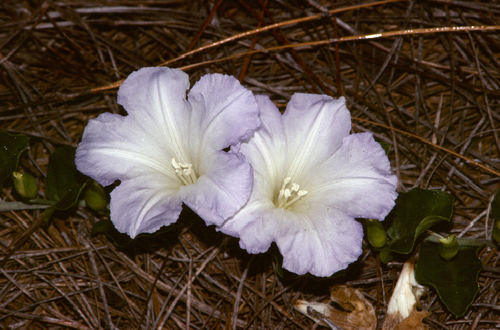
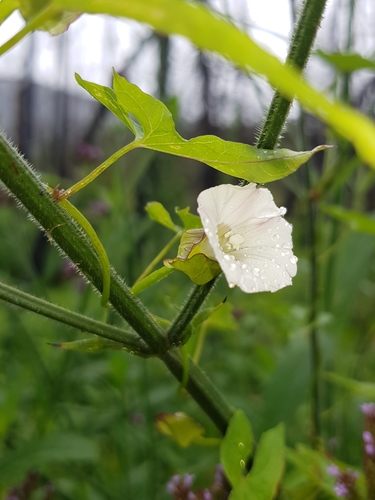
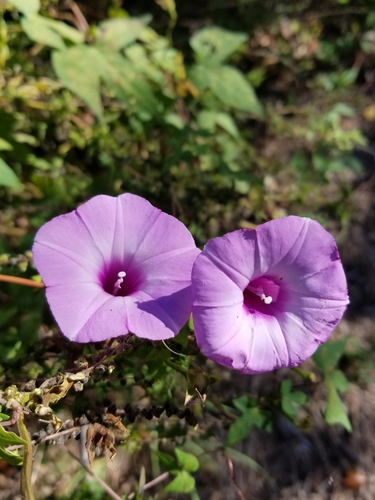
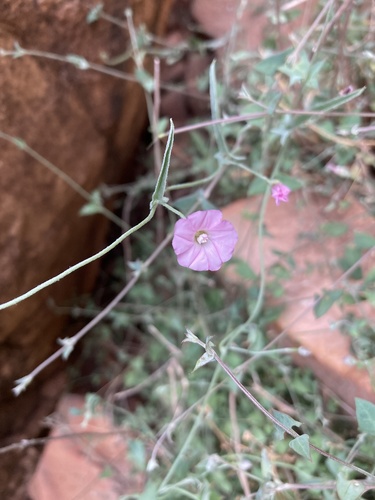
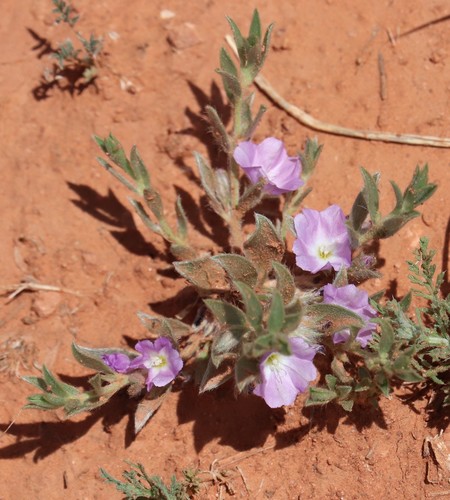
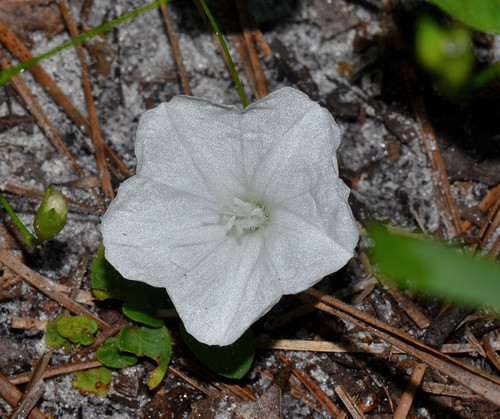
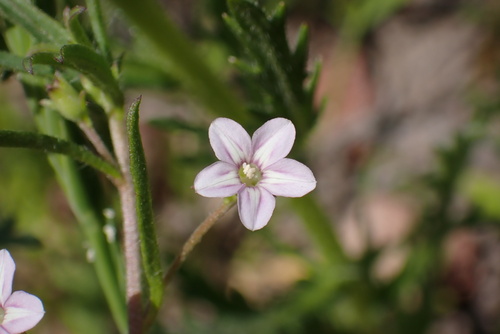
Convolvulus simulans Perry is an annual herb with a vining or spreading growth habit. Unlike many vining plants, it does not twine around other shrubs; instead, it grows in a mostly decumbent form, and sometimes loops its stems around other plants. Its stems are less than 1.5 mm (0.059 in) in diameter and can spread across the ground up to 40 cm (16 in) long. Leaves are arranged alternately along the stems, and taper toward a weakly defined petiole that connects the leaf to the stem. Leaf blades range in shape from narrowly oblanceolate to nearly linear, with smooth margins. All above-ground plant parts are covered in small, soft hairs. Flowers grow singly, produced from 1-flowered cymes that emerge from the axils of the plant's upper leaves. The peduncle is short, measuring 3–20 mm (0.12–0.79 in) long, and becomes sharply nodding once the plant develops fruit. Small bracts, 3–7 mm (0.12–0.28 in) long and linear or narrowly oblanceolate in shape, grow on the peduncle 2–5 mm (0.079–0.197 in) below the calyx. On the open flower, the calyx lobes are 3–4 mm (0.12–0.16 in) long and oblong-ovate in shape. The corolla is bell-shaped, about 0.6 cm (0.24 in) long, and split into 5 lobes (functionally petals). These lobes are white or pale pink, marked with blue or lavender stripes. This species flowers from April to June, and produces a round, 4-seeded capsule as its fruit. This plant is native to the United States and Mexico, occurring within Arizona, California, and Baja California. In Arizona, it is found in Gila County's Tonto Basin. In California, it grows in the southern Sierra Nevada foothills, the San Francisco Bay Area, the South Coast Ranges, and the Channel Islands, with the densest populations in southern California. In Baja California, it occurs in the northwestern part of the state, ranging south to El Rosario. This species grows primarily on heavy, cracking, friable clay substrates, and more rarely on serpentine soil. It is often found in vernal pools, and its typical associated habitats include annual grasslands, coastal sage scrub, and chaparral, at elevations between 30 and 875 m (98–2,871 ft).