About Convolvulus arvensis L.
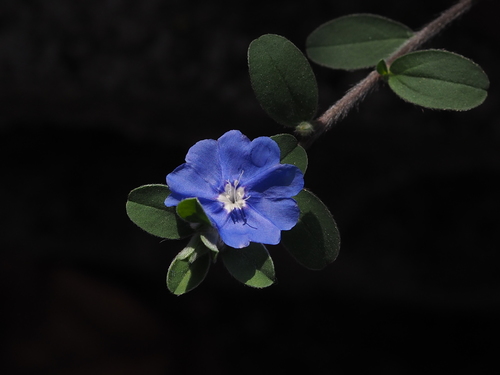
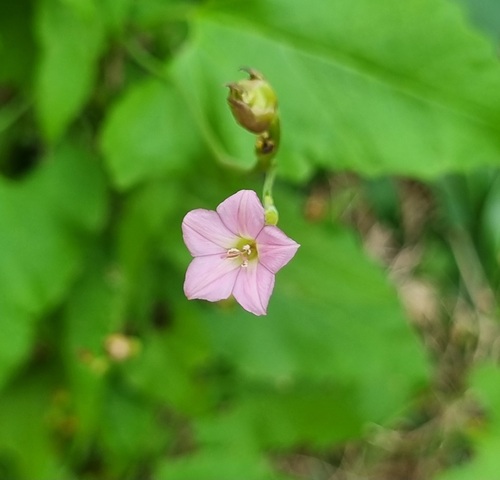
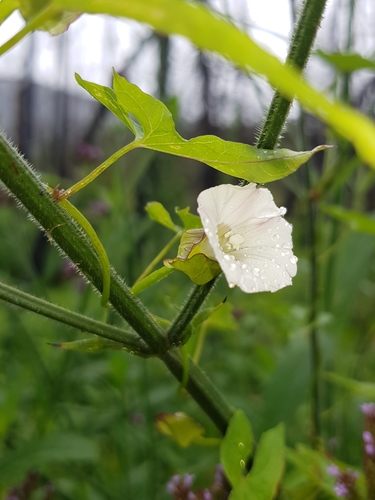
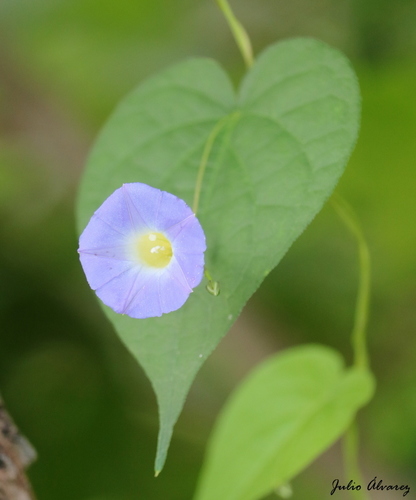
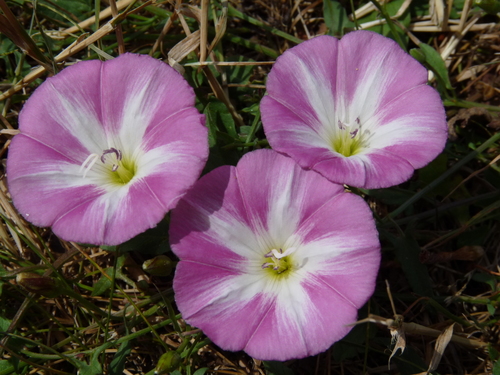
Convolvulus arvensis L. is a perennial vine that typically climbs to 1 metre (3.3 ft). This species produces woody rhizomes, which allow it to resprout in spring, or regrow after its aboveground vines are removed. Its leaves are alternately arranged in a spiral pattern; they range from linear to arrowhead-shaped, 2–5 cm (0.79–1.97 in) long, and grow from a 1–3 cm (0.39–1.18 in) petiole. Stems climb by twisting counter-clockwise around the stems of other plants. The flowers are trumpet or funnel-shaped, 1–2.5 cm (0.39–0.98 in / 0.75–1 in) in diameter, white or pale pink with five slightly darker pink radial stripes. Flowers are subtended by small bracts, and flowering occurs in mid-summer: from June to September in the United Kingdom. The fruit are light brown, rounded, and 3.2 mm (0.125 inches) wide. Each fruit holds 2 or 4 seeds; these seeds are eaten by birds and can remain viable in soil for decades. In terms of ecology, C. arvensis is most commonly found growing on farmland, in waste places, along roadsides, in pastures, on grassy slopes, and alongside streams in North America. It can colonize hot asphalt surfaces, spreading from road edges and growing between pavement stones. In China, it grows at altitudes between 600 and 4,500 metres (2,000 to 14,800 ft) and is absent from warmer southern provinces. It prefers dry areas with humus-poor, nutrient-rich alkaline soils, and is a characteristic species of the phytosociological vegetation association Convolvulo-Agropyretum, which belongs to the couch grass dry grasslands alliance Convolvulo-Agropyrion repentis in syntaxonomy. Like other Eurasian Convolvulus bindweeds, C. arvensis is specifically pollinated by oligolectic (specialist) sweat bees in the genus Systropha, which feed only on these plants. These bees have an unusual modified scopa: unlike most bees that carry pollen on their legs, Systropha carry pollen on almost their entire abdomen, including the dorsal surface. In central Europe, two uncommon Systropha species, S. curvicornis and S. planidens, are almost entirely dependent on C. arvensis. While both specialize on this same plant species, S. curvicornis is a habitat generalist, and S. planidens is restricted to steppe habitats, though the two species can occur together. Males of both species establish territories around patches of bindweed flowers. After patrolling their territory, they perch on flowers during the afternoon. If a rival conspecific male enters the territory, the resident male attacks the intruder by ramming him from the air with a specialized protuberance on his lower abdomen. Bumblebees, honey bees, or other non-rival insects may be bombed with air attacks, but never rammed. As flowers close in the late afternoon, males retreat inside the flower to spend the night, and emerge at dawn before or after the flower fully reopens; females instead stay in underground tunnel nests. Males only land on flowers (occasionally flowers of other plant species) and avoid other perches, feeding on the flowers' nectar. Females forage for nectar and pollen during the morning and early afternoon when flowers are open. Most mating takes place within bindweed flowers: when a virgin female enters a male's territory and the larger male finds her feeding at a flower during his morning patrol, the male immediately pounces on her and engages in copulation, which takes an average of 90 seconds. These Systropha bees are in turn parasitized by the cuckoo bee Biastes brevicornis. For chemistry and human uses, bindweed contains multiple alkaloids toxic to mice, including pseudotropine, with smaller amounts of tropine, tropinone, and meso-cuscohygrine. These alkaloids are also reported to give the plant psychoactive properties. Its leaves contain glycosides, and have been used traditionally to treat hypertension, and as a laxative and diuretic.