About Conus geographus Linnaeus, 1758
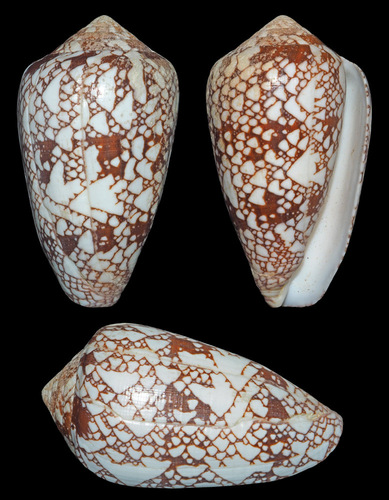
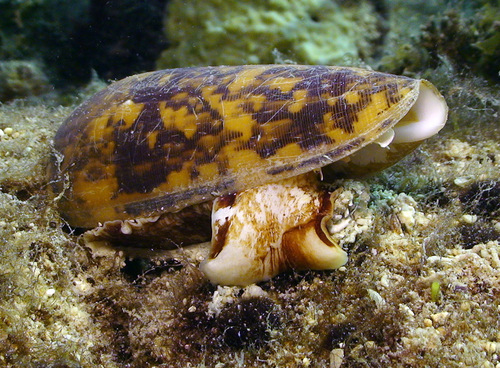
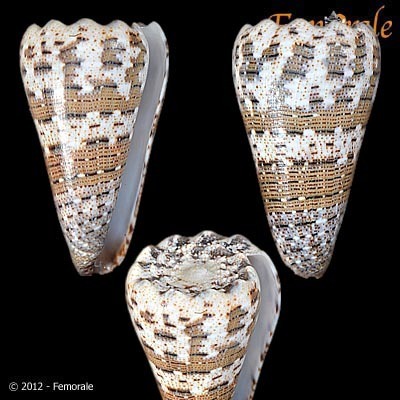
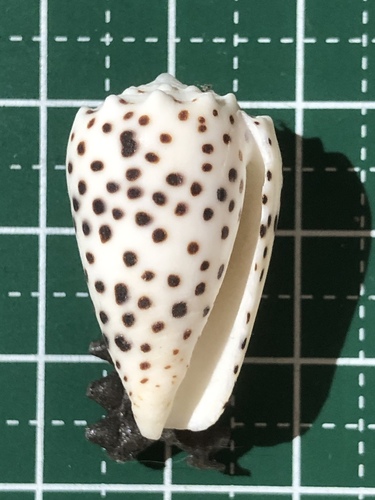
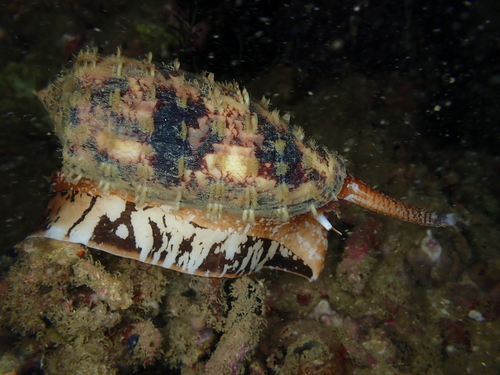
Conus geographus Linnaeus, 1758, commonly called the geography cone, has a broad, thin, cylindrically inflated shell. Adult geography cones reach a length of 10 to 15 cm (4 to 6 in), and the full size range of adult shells falls between 43 mm (1.7 in) and 166 mm (6.5 in). The base shell color is pink or violaceous white, and is occasionally reddish. The shell has a mottled look, clouded and coarsely reticulated with chestnut or chocolate markings that usually form two very irregular bands. This intricate brown-and-white pattern is highly valued by shell collectors. The geography cone has a wide, violaceous white or pink aperture, and numerous shoulder ridges or spines. The shell is covered with fine thread-like revolving striae, which are usually nearly indistinct except at the base of the shell. Its flattened spire is striated and coronated. Compared to other cone snail species, this species has a noticeably wider, convex mid-body and a flattened spire. Its shell walls are also noticeably thinner and lighter than other cone shells of similar length and size. Geography cones are common. Their distribution includes the Red Sea, the Indian Ocean off Chagos, Réunion, Madagascar, Mauritius, Mozambique and Tanzania. They are native to reefs across the Indo-Pacific region, with the exception of Hawaii, and are found off the coast of Australia in the Northern Territory, Queensland, and Western Australia. Because the distribution of C. geographus is heavily shaped by habitat temperature, climate change is predicted to alter its distribution over the coming decades. By 2090, parts of the seas around South-East Asia are predicted to become more suitable for this species, while parts of Australia and Africa's eastern coast are predicted to become less suitable. C. geographus is a fish-eating species (piscivore) that lives in sediment on shallow reefs, and preys on small fish. Like all other cone snails, it fires a harpoon-like, venom-tipped modified tooth into its prey. This harpoon is attached to the snail's body by a proboscis, and the prey is pulled inside the body for ingestion.