About Contopus cooperi (Nuttall, 1831)
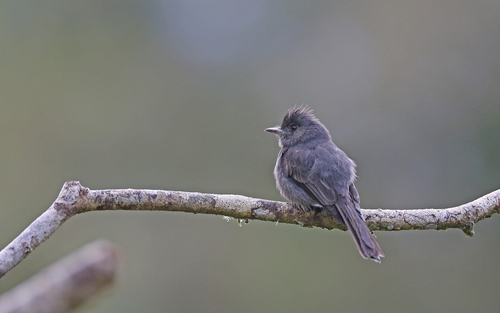
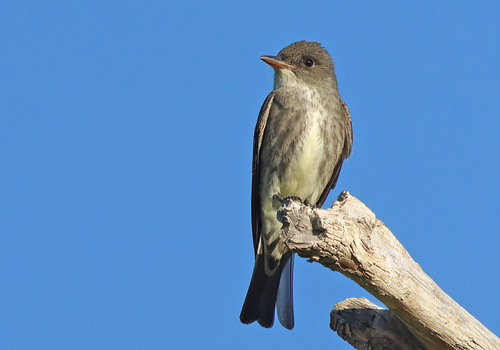
Identification: The olive-sided flycatcher (Contopus cooperi) is a small to medium-sized passerine bird. It is smaller than an American robin, but larger than sparrows. It can be identified by olive-grey or grey-brownish plumage on its upper body, paired with a white throat and white section down the center of its breast. The olive tones on its back and wings are most visible in optimal light, and when its feathers are freshly moulted. The sides of its breast are grey, giving the bird the appearance of wearing a vest. For its body size, it has a relatively long bill and long wings. Sometimes, the feathers on its head can be raised to form a small-looking crest. Males and females have similar plumage and appearance. Olive-sided flycatchers typically perch upright on the tops of dead branches or dead trees. Distribution and habitat: The olive-sided flycatcher is distributed across North and South America. Its breeding range extends from California and New Mexico north to central Alaska, then across Canada (excluding most of the Northwest Territories and Nunavut) and into a portion of the northeastern United States. Its non-breeding range is primarily in northern South America, with a small non-breeding population in Central America. Breeding habitat mainly consists of open areas or forest edges in boreal coniferous forests or temperate western forests, at elevations up to 10,000 feet, for example in the Rocky Mountains. Breeding sites are always located near water, and the birds may also nest in cities or on farms. In their non-breeding range, olive-sided flycatchers use similar habitats to their breeding range, including open areas and forest edges. However, they do not require proximity to water as strongly as they do during breeding. They are also associated with habitats that contain very tall trees. Two forest habitats used by olive-sided flycatchers during the winter are tropical montane and tropical lowland evergreen forests. Reproduction: Olive-sided flycatchers breed once per year. They usually lay clutches of 3 to 4 eggs. Both the incubation period and the nestling stage last 15 to 19 days. Eggs are approximately 0.8–0.9 inches long and 0.6–0.7 inches wide. They are creamy white with brownish spots that form a ring around the larger end of the egg. The female chooses the nest location, which is usually on a horizontal branch of a coniferous tree, though nests have also been observed on other tree types. Recorded nest heights range from 5 feet to 197 feet above ground. In the western part of the species' range, olive-sided flycatchers tend to build higher nests than they do in the eastern part of the range. The nest is cup-shaped; it is around 4.6 inches wide on the outside, and 2.8 inches wide on the inside. The outer structure of the nest is built from twigs and small branches, while the inner cavity is usually lined with finer material such as grass, lichen, and conifer needles. Hatchlings are born naked and helpless. The male defends a large area around the nesting territory. Both parents provide food for the young birds.