About Conocybe apala (Fr.) Arnolds
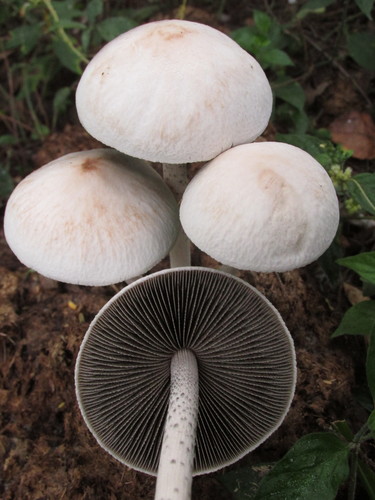
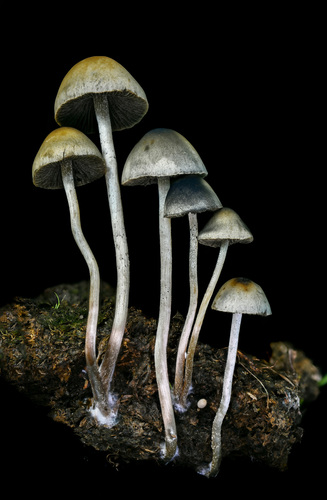
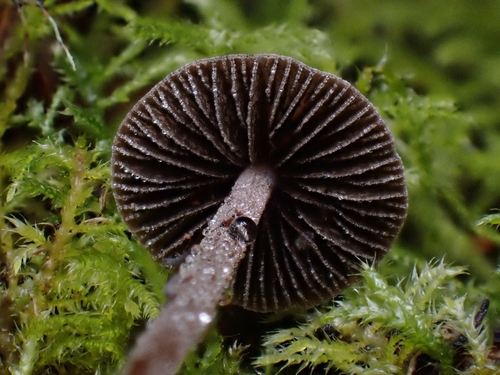
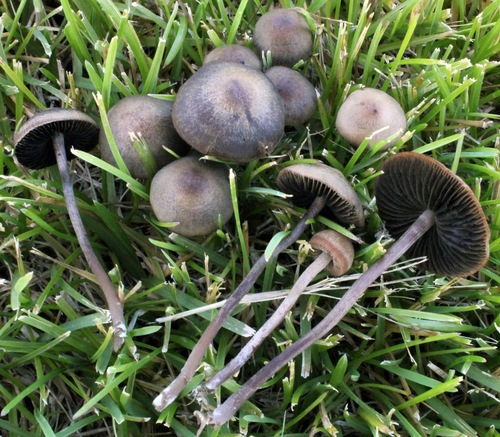
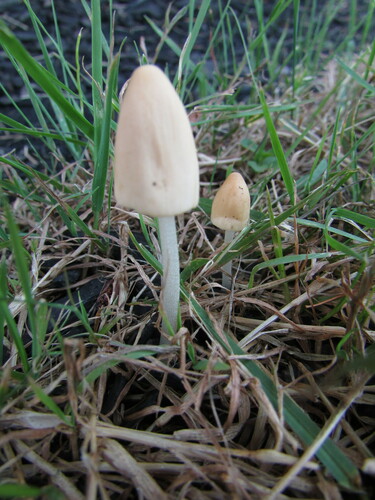
Conocybe apala (Fr.) Arnolds has caps ranging from 1 to 3.5 centimetres (1⁄2 to 1+1⁄2 inches) in diameter. Caps are colored pale cream to silvery-white, and may sometimes have a darker yellow to brown coloration toward the central umbo. Its characteristic hood-shaped conical cap expands as it ages and may flatten out, with the cap surface marked by tiny radiating ridges. The stem matches the cap in color, it is elongated, thin, hollow, and roughly equal in thickness along its length, reaching a height up to 11 cm (4+1⁄4 in) with a diameter of 1 to 3 mm. The stem may hold dust and/or bear small hairs. The gills are closely spaced and tan when young, darkening to brown as they mature. Gills are either adnexed or free, and produce a rusty-brown spore print. Spores are elliptical, and colored brown to reddish-brown. While their very small size makes them very easy to overlook, fully formed fruit bodies are otherwise quite simple to identify. The flesh has no distinct taste or smell, and is extremely fragile to the touch. Conocybe apala is a saprobe that grows in areas with rich soil and short grass, including pastures, playing fields, lawns, and meadows, as well as on rotting manured straw. It fruits singly or in small sparse groups of short-lived ephemeral fruiting bodies. It commonly fruits during humid, rainy weather with mostly overcast skies. It can appear on sunny mornings when dew is present, but does not persist after the dew evaporates. In most cases, by midday the delicate fruiting bodies shrivel, dry out, and bend out of sight. Its fruiting season runs from spring through autumn. This species is distributed across Europe and North America.