About Connochaetes taurinus (Burchell, 1823)
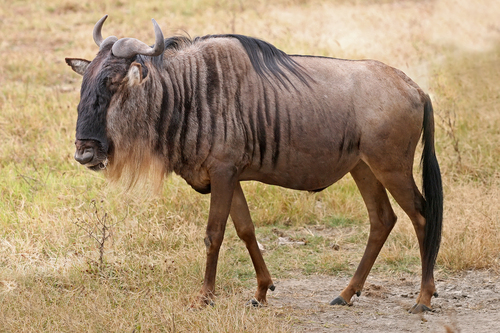
Connochaetes taurinus (Burchell, 1823), commonly called the blue wildebeest, shows clear sexual dimorphism: males are larger and darker than females. Head-and-body length for the species typically ranges from 1.7–2.4 m (5.6–7.9 ft), with an average shoulder height of 1.15–1.45 m (3.8–4.8 ft). Males usually weigh between 165 to 290 kg (364 to 639 lb), while females weigh 140 to 260 kg (310 to 570 lb). One of the species' defining traits is a long black tail, measuring around 60–100 cm (2.0–3.3 ft) long. All physical features and markings of blue wildebeest are bilaterally symmetrical in both sexes. The average lifespan of blue wildebeest in captivity is 20 years; the oldest known captive individual lived 24.3 years, while the maximum wild lifespan of this species is unconfirmed. Blue wildebeest have one of the most energy-efficient locomotor muscle systems recorded: 62.6% of energy is converted into mechanical movement, with the remainder lost as heat. They can travel up to 80 km (50 mi) over 5 days without drinking water, even when peak daytime average temperatures reach 38 °C (100 °F).
Blue wildebeest are native to southern and eastern Africa, specifically Kenya, Tanzania, Botswana, Zambia, Zimbabwe, Mozambique, South Africa, Eswatini, and Angola. They are currently extinct in Malawi, but have been successfully reintroduced to Namibia. They primarily inhabit short-grass plains that border bush-covered acacia savannas, and thrive in habitats that are neither excessively wet nor overly arid. Their range includes habitats from overgrazed areas with dense bush to open woodland floodplains, where trees such as Brachystegia and Combretum species are common. Blue wildebeest can tolerate arid regions if a drinking water supply is available within approximately 15–25 km (9.3–15.5 mi) of their range. The species' southern range limit is the Orange River, while its western limit is defined by Lake Victoria and Mount Kenya. Blue wildebeest do not occur in montane or temperate grasslands, and are rarely found at altitudes over 1,800–2,100 m (5,900–6,900 ft). With the exception of a small population of Cookson's wildebeest in Zambia's Luangwa Valley, blue wildebeest are absent from the wetter regions of southern savanna countries, and are specifically not found in miombo woodlands.
Three remaining African blue wildebeest populations participate in long-distance annual migrations, timed to match rainfall and grass growth patterns on nutrient-rich short-grass plains that support lactation and calf growth. The timing of both directions of migration can vary substantially from year to year. At the end of the rainy season, the animals migrate to dry-season ranges when drinking water becomes scarce. When the rainy season returns a few months later, they travel back to their wet-season ranges. Migratory populations can reach much larger sizes than non-migratory resident populations, due to these long movements and consistent access to nutrient-rich forage for reproduction. While many long-distance migratory blue wildebeest populations existed 100 years ago, all but three migrations—those in the Serengeti, Tarangire, and Kafue—have been disrupted, fragmented, or lost entirely.
Blue wildebeest are most active in the early morning and late afternoon, resting during the hottest hours of the day. They are extremely agile, wary animals that can run at speeds up to 80 km/h (50 mph). A study of blue wildebeest activity in Serengeti National Park found the species spends over half of its total time resting, 33% of time grazing, 12% of time moving (mostly walking), and a small portion of time on social interactions, though activity patterns vary between age and sex groups. Blue wildebeest generally rest near other members of their species and move in loose aggregations. Males form bachelor herds, which can be told apart from juvenile groups by lower overall activity and wider spacing between individuals. Around 90% of male calves join bachelor herds before their next mating season. Bulls become territorial at 4 to 5 years of age, becoming notably noisy and active. Territorial bulls can tolerate close proximity to one another, with up to 270 bulls able to occupy one square kilometre (0.39 sq mi) of plain. Most territories are temporary, and fewer than half of all males hold permanent territories. At night, blue wildebeest rest in groups ranging from a few individuals to thousands, with a minimum distance of 1–2 m (3–7 ft) between individuals, though mothers and calves stay in close contact. Blue wildebeest are a primary prey species for lions, cheetahs, leopards, African wild dogs, hyenas, and Nile crocodiles.
Female calves stay with their mothers and other related females in the herd for their entire lives. Herds contain females of all ages, from yearlings to the oldest breeding cows. During the wet season, females generally lead the herd to nutrient-dense grass areas that also offer better protection from predators, to maximize newborn calf survival and access to nutritious milk for calves. Territorial bulls mark their territory boundaries with dung heaps, scent gland secretions, and specific displays. Territorial male body language includes an erect standing posture, extensive pawing and horning of the ground, frequent defecation, rolling, bellowing, and producing a distinct "ga-noo" sound. When competing for territory, males grunt loudly, paw the ground, make thrusting movements with their horns, and perform other aggressive displays.
Male blue wildebeest reach sexual maturity at around 2 years of age. Females can conceive at 16 months old if well-nourished, but most do not begin breeding until they are 2 years old. The 3-week mating season lines up with the end of the rainy season, when blue wildebeest are in good condition from eating nutrient-dense new grass growth, and conception rates often reach as high as 95%. The mating season (rut) typically begins on the night of a full moon, indicating the lunar cycle influences breeding timing. At this time, male testosterone production peaks, leading to increased calling and territorial behavior. The activity of these sexually excited males also stimulates females to enter estrus.
Males compete for territory and access to females, engaging in ritualized rivalry. When clashes occur, they face each other with bent knees and exchange horn thrusts, alongside elaborate individual displays including bellowing, snorting, and digging their horns into the ground. After dominance is established, each male attempts to lure receptive females into his territory. During courtship, common behaviors include urination and a low-stretch posture, and the male soon attempts to mount the female. A receptive female holds her tail to one side and stands still during copulation. Mating may be repeated multiple times, even two or more times within one minute. When a female is in his territory, the male does not eat or rest, and the female stays close to the male, often rubbing her head on his torso and sniffing his penis. While in estrus, a female may visit multiple territories and mate with several different males.
Gestation lasts around 8.5 months, and 80 to 90% of all calves are born within a single 3-week window. Females give birth in the middle of the herd rather than in isolation, usually during midday. This timing allows newborn calves to gain steady footing before nightfall, when predators are more active. Calves weigh around 19 kg (42 lb) at birth, and can usually stand on their own within a few minutes of birth. To avoid predation, calves stay close to their mothers for an extended period, and continue suckling until the next year's calf is nearly due. Male calves leave their mothers at around 8 months old and join herds with other juvenile males. In large female herds, 80% of wildebeest offspring survive their first month, compared to a 50% first-month survival rate in smaller female herds.