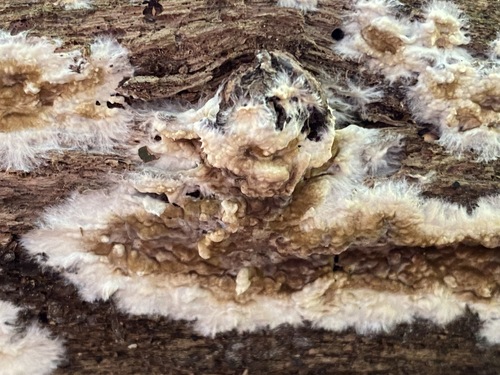
About Coniophora puteana (Schumach.) P.Karst.
Coniophora puteana (Schumach.) P.Karst., commonly called cellar fungus, is a brown rot wet rot fungus that belongs to the division Basidiomycota. It forms large brown patches with surrounding white edges, and typically grows on pine and hardwood in humid environments. Its mycelium is not always visible, and it often leaves a very thin layer of healthy wood intact. This makes the fungus extremely difficult to detect before the affected structure becomes unstable. Unlike most brown rot fungi, C. puteana decays wood in a pattern that is more similar to white-rot fungi: it thins cell walls and leaves cavities within the wood substrate. Unlike other common wet rot fungi, C. puteana requires consistently high humidity, averaging around 50-60%. Because of this humidity requirement, it grows on wood near water leaks or in naturally humid locations, and is not restricted to common sites like cellars. Coniophora puteana has a very widespread distribution, and occurs on most continents including North America, South America, Europe, India, Africa, Australia, and Asia. It is most prevalent in eastern North America and western Europe. It is most commonly found during the autumn, specifically in the month of October.

