About Conger oceanicus (Mitchill, 1818)
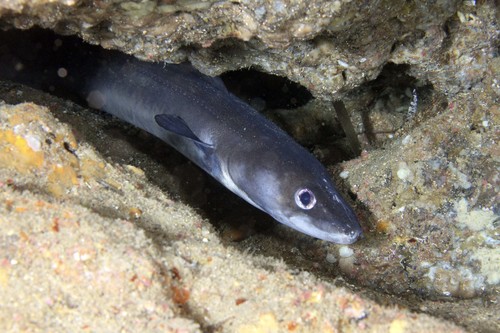
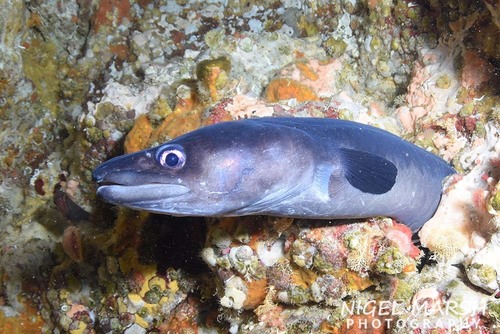
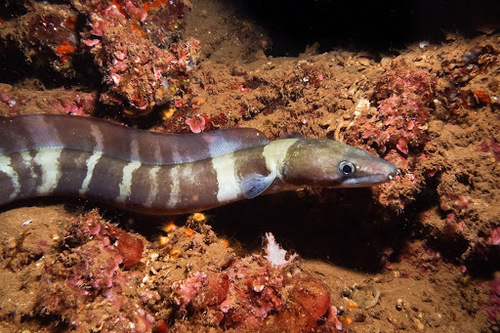
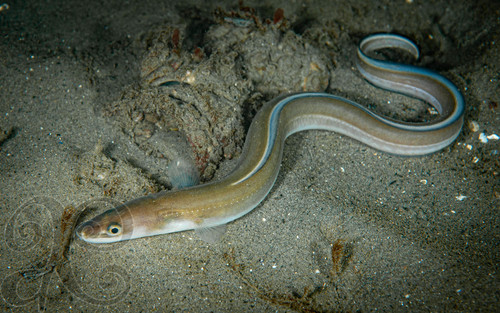
Conger oceanicus, commonly known as the American conger, is a large, elongated, cylindrical fish. It reaches a maximum length of over 2 meters (6.6 feet) and a maximum weight of over 40 kilograms (88 pounds), with a more typical adult length of around one meter. Its upper jaw projects further forward than its lower jaw. The dorsal fin begins just behind the pectoral fins, extending as a continuous even ribbon to the tip of the tail, where it fuses with the similarly long, uniform anal fin. This species has a dark gray-toned dorsal surface and a whitish ventral surface, and both the dorsal and anal fins have dark margins. American conger is a seabed-dwelling eel and a nocturnal predator. Its diet is made up mainly of fish, and it also feeds on molluscs and crustaceans. It is a migratory species: while juvenile American congers use estuaries, the species does not have a freshwater life phase, unlike some other eel species. In summer, mature individuals leave the continental shelf, cross the Gulf Stream, and travel to the Sargasso Sea north of the Bahamas. They spawn in floating sargassum masses here during autumn and winter, and are believed to die after spawning. The larvae, called leptocephali, leave the algal mass after hatching and are soon carried by the Gulf Stream. They develop through four larval stages before undergoing metamorphosis into elvers when they reach approximately 10 centimeters (4 inches) in length. After leaving the Gulf Stream, they swim toward the coast, where they become benthic and may enter river mouths. They are cryptic during this life stage, so they are difficult to study.