About Conger conger (Linnaeus, 1758)
Conger conger, the European conger, is the world's heaviest species of eel. Adult European congers average 1.5 m (5 ft) in length, with a confirmed maximum length around 3 m (9.8 ft) and a confirmed maximum weight of roughly 72 kg (159 lb); unconfirmed records note weights that may reach up to 160 kg (350 lb). While the largest moray eel species can match or slightly exceed this species in length, moray eels are more slender and therefore weigh less than large European congers. The average weight of an adult caught by fishers is only 2.5 to 25 kg (5.5 to 55.1 lb). Females are significantly larger than males at sexual maturity: females average 2 m (6 ft 7 in) in length when mature, while males average 1.2 m (3 ft 11 in) at maturity.
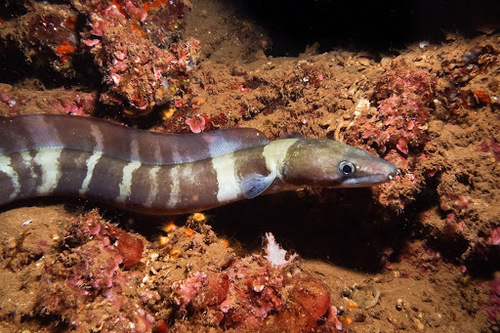
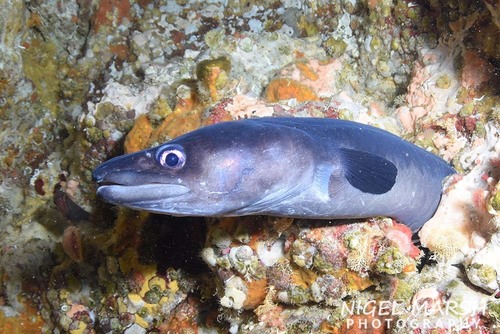
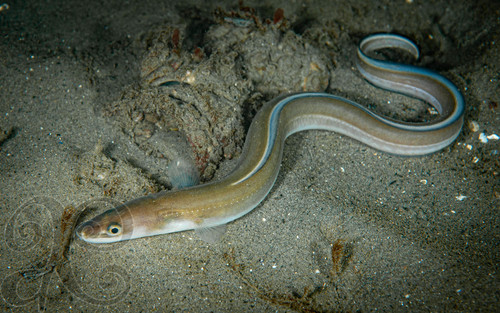
European congers have a very long, eel-shaped scaleless body. Their base color is most often grey, but may also be blackish, and their belly is white. A line of small white spots runs along the lateral line on their flank. Their head is roughly conical and slightly flattened, with a rounded, prominent snout that has lateral olfactory openings. They have large, laterally positioned gill openings, and conical teeth arranged in rows along their jaws. Their dorsal and anal fins connect directly to their caudal fin; they have pectoral fins, but lack ventral fins entirely.
European congers share similar habits with moray eels. They typically live among rocks in holes called "eel pits", and sometimes share these holes with moray eels. They are nocturnal predators that leave their hiding spots to hunt at night. Their diet mainly consists of fish, cephalopods, and crustaceans; they actively hunt live fish, and are also thought to scavenge on dead and rotting fish. Congers can behave aggressively toward humans, and large specimens are dangerous to divers.
This species is found in the eastern Atlantic Ocean, ranging from Norway and Iceland south to Senegal. It also inhabits the Mediterranean Sea and the Black Sea. It normally occurs at depths between 0 and 500 m (0 and 1,640 ft), though it may reach depths of up to 3,600 m (11,800 ft) during migrations. It is sometimes sighted in very shallow nearshore water, and has also been recorded as deep as 1,170 m (3,840 ft). It typically lives on rough, rocky, uneven seabed. Young European congers stay close to the coast, while adults move into deeper waters.
When European congers reach 5 to 15 years of age, their bodies go through a transformation in preparation for reproduction: the reproductive organs of both sexes increase in size, the skeleton loses mass, and their teeth fall out. Females gain more weight and size during this transformation than males do. The eels then migrate to spawning grounds in the Mediterranean and Atlantic, though it remains uncertain whether the species uses just one or multiple separate spawning grounds. Females produce several million eggs, and both male and female European congers die immediately after spawning. After hatching, larval congers swim back to shallower waters, where they live until they reach maturity. Mature eels then migrate to spawning grounds to repeat the life cycle.