About Conepatus leuconotus (Lichtenstein, 1832)
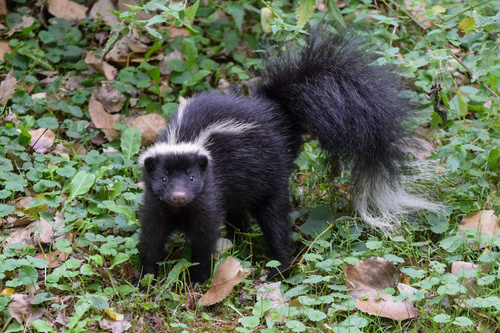
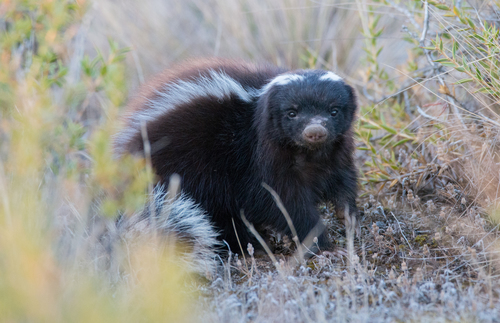
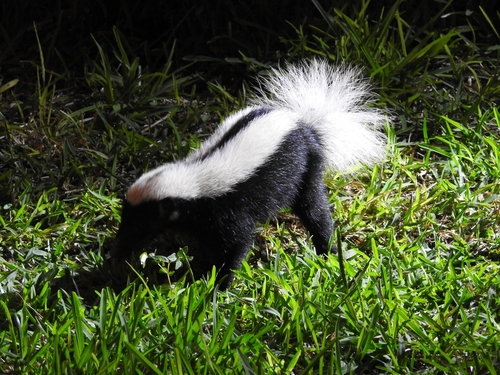
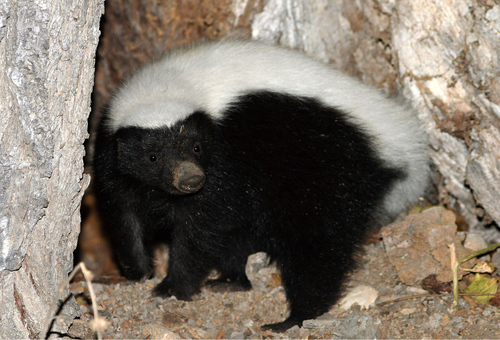
The American hog-nosed skunk, Conepatus leuconotus, has a distinct appearance: it bears one broad white stripe running from the top of its head to the base of its fully white tail. It is the only skunk that has no white dot or medial bar between its eyes, and its body fur is primarily black. Its snout is relatively long, with a hairless nose pad that resembles the nose of a small hog. This nose pad, which measures 20 mm wide by 25 mm long, is roughly three times wider than the nose pad of the striped skunk Mephitis mephitis. The species has small, rounded ears and relatively small eyes. Its fur is short and coarse. American hog-nosed skunks have stocky legs and plantigrade feet, meaning their entire foot sole touches the ground. Their broad, large hind feet have hairless soles covering roughly half their length. They have a powerfully built upper body and very long fore claws. Total body length ranges from 44.4 to 93.4 cm (17.5 to 36.8 in), and adult weight typically falls between 1,130 and 4,500 g (2.49 to 9.92 lb). While the striped skunk can broadly overlap in size with this species, the striped skunk has a shorter head-and-body length and a longer tail than the American hog-nosed skunk. Males of this species average about 10% larger than females. This species is adapted for digging, and its digging-related anatomy more closely resembles that of badgers than other skunk species. Its rectangular scapula, strong forearms, and humerus shape match the corresponding badger structures. Its nostrils are positioned ventrally and open downward. It has an acute sense of smell, and uses its nose to locate and capture buried prey. It is also a capable climber, though it is not as agile as spotted skunks of the genus Spilogale. This skunk occurs in canyons, along stream sides, and on rocky terrain. Across Mexico, it has been recorded in a wide range of habitats, including open desert scrub, mesquite grasslands, tropical areas, mountains, coastal plains, cornfields surrounded by brushland or adjacent to grassy plains and bull-horn acacia thickets, thorn woodland, and riparian forests dominated by live oaks, pecans, sycamores, and Texas persimmons with an understory of briars, grasses, and weeds. It is also found in pine-oak forests, as well as scrub and cactus habitats. In Kleberg County, Texas, it lives in mesquite brushland, pastures, and native grassland used exclusively for cattle ranching. Thorny brush and cactus are the dominant vegetation in the southern Texas regions where this species occurs. It is omnivorous, feeding primarily on insects and vegetation, though it will eat small mammals and reptiles when these prey are available. Crop farmers sometimes consider it a pest because of its rooting behavior, but this label is largely undeserved, as it generally prefers insects over agricultural plants. Like all skunk species, it has powerful anal glands it uses to deter potential attackers. For reproduction, C. leuconotus breeds from late February through early March, and most adult females are pregnant by the end of March. Gestation typically lasts around 60 days, with births occurring in April and May. Half-grown young have been observed in late July and mid-August, and young begin dispersing by late August. Litter size ranges from one to five young, with two to four being the most common.