About Condylactis gigantea (Weinland, 1860)
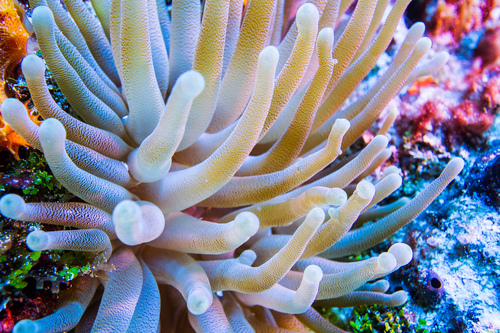
Condylactis gigantea, formally described by Weinland in 1860, is a tropical ball anemone species. It lives in shallow reefs and other shallow inshore areas of the Caribbean Sea (particularly the West Indies) and the western Atlantic Ocean, ranging from southern Florida through the Florida Keys. This species has several common names: giant Caribbean sea anemone, giant golden anemone, condylactis anemone, Haitian anemone, pink-tipped anemone, purple-tipped anemone, and Florida condy. Individuals can be easily observed growing in lagoons or inner reefs, either alone or in loose groups, and never forms colonies. Along with other members of its genus, it is often used as a model organism to study facultative symbiosis with single-celled algae. The giant Caribbean sea anemone typically anchors to hard substrates such as rocks, shells, and other solid objects in the crevices of rock walls, in shallow water that is almost always full-strength seawater, which may account for its common occurrence in Bermuda. It is also very abundant around reefs in both forereef and lagoon regions. It can also be found in most inshore areas and on coral reefs, though occurrences in these locations are less common. While sea anemones as a group can live from the intertidal zone down to 30,000 feet deep, C. gigantea occupies shallow inshore and reef habitats. In its subtidal communities, C. gigantea plays an important ecological role: it provides shelter for a range of commensal organisms, including several fish and cleaner shrimp species, and acts as a base station for fish cleaning behavior. The primary mating season of the giant Caribbean sea anemone is reported to be late May, but it may reproduce at low levels throughout the rest of the year. This anemone is usually dioecious, but is occasionally hermaphroditic. It has a 1:1 male-to-female sex ratio, and there is no evidence of brooding, asexual reproduction, or division by furrowing. Its reproductive strategy is classified as oviparous, with planktonic, lecithotrophic larvae. Spawning of eggs and sperm is relatively synchronized, and fertilization happens externally in the water column. Fertilization success depends on separate-sexed anemones being in close proximity to one another. Fertilization produces a planula larva that gets its nutrients from yolk, so starvation death of larvae is unlikely, which makes dispersal a beneficial survival strategy for the species. After dispersal, the planula larva settles on the benthos, develops a pedal disc, and eventually grows into a fully mature anemone.