About Comptonia peregrina (L.) J.M.Coult.
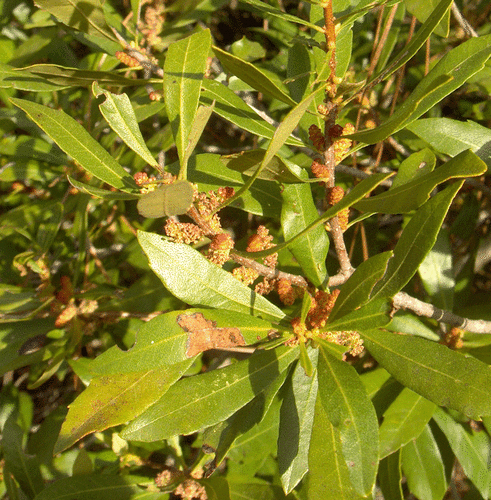
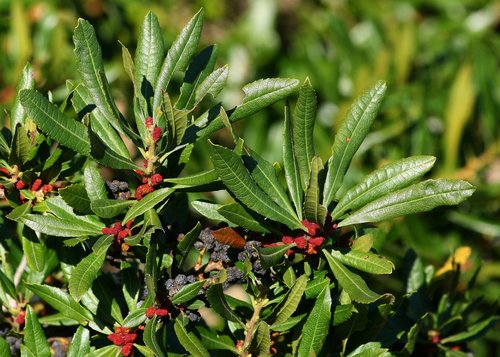
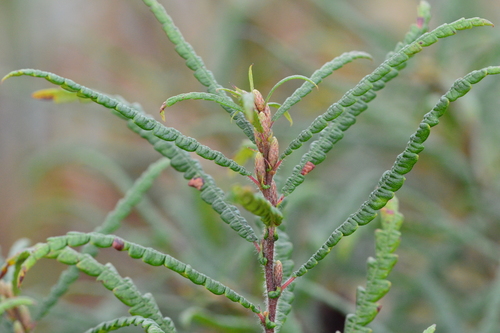
Comptonia peregrina (L.) J.M.Coult. is the only currently living species in its genus. It is a deciduous shrub that reaches 1.5 m (4.9 ft) in height. Its leaves range from linear to lanceolate, measuring 3–15 cm (1.2–5.9 in) long and 0.3–3 cm (0.1–1.2 in) wide, with lobed margins. The leaves release a sweet scent, particularly when crushed. This species is monoecious, producing separate unisexual flowers on the same individual. Staminate flowers grow in clusters at branch tips, reaching up to 5 cm (2.0 in) long. Pistillate flowers are only 5 mm (0.2 in) when young, but elongate as fruits develop, eventually reaching 5 cm (2.0 in) in length. This shrub is native to eastern North America. Its native range extends north to the Canadian provinces of Ontario and Quebec, east to Nova Scotia, south to extreme northern Georgia, and west to Minnesota. It typically grows on dry sandy sites and is most often found associated with pine stands. In ecological terms, Comptonia peregrina acts as a food plant for the larvae of multiple Lepidoptera species. These include Bucculatrix paroptila, grey pug, setaceous Hebrew character, Io moth, and several case-bearer moth species from the genus Coleophora: C. comptoniella, C. peregrinaevorella (which feeds only on Comptonia), C. persimplexella, C. pruniella, and C. serratella. It is a non-legume nitrogen fixer adapted to wet soils, and also has resistance to drought. The plant produces a bristly burr that holds 1 to 4 edible nutlets. Its aromatic leaves, used either fresh or dried, are brewed to make tea. Canadian author Catharine Parr Traill included this plant in her work *The Female Emigrant's Guide* as a substitute for China tea. She notes that when boiled, the tea has a slightly resinous taste with a mild bitter flavour that is not unpleasant. Traill mistakenly identified the plant as a fern, and stated that it was held in high regard by Yankee and old Canadian housewives (spelled sic in the original source). Topically applied tea made from this plant has been said to treat the effects of poison ivy on affected areas. The plant can also be used as a seasoning.