About Compsistis bifaciella (Walker, 1864)
Dugdale described the larva of Compsistis bifaciella with the following characteristics: Its body only has bands of short, stiff setulae located on broad sclerites called pinacula. The thoracic SV setal group, which sits above the base of the foreleg, holds 6 to 10 short setulae arranged in a horizontal line. On the ventral side of the head capsule, the menrum is simple, with no concave sclerite and no paired dark slits. A fully grown larva reaches a body length of 10 mm.
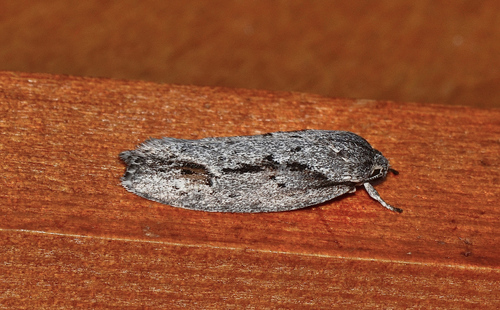
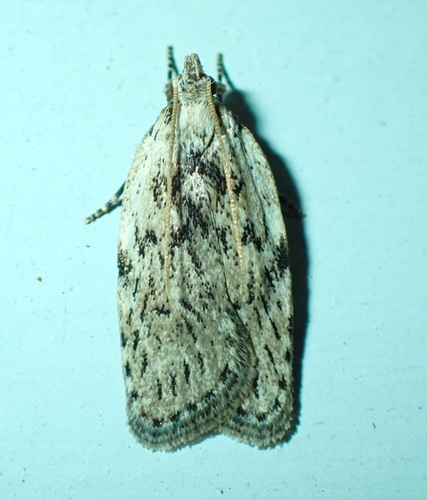
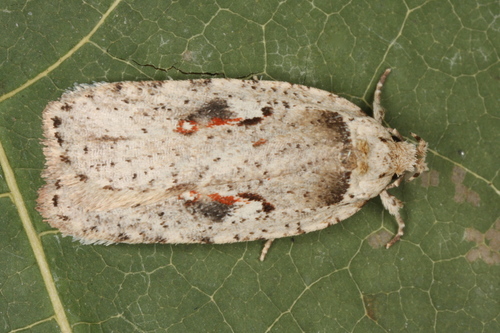
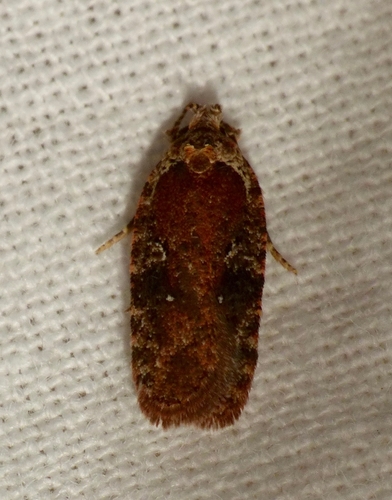
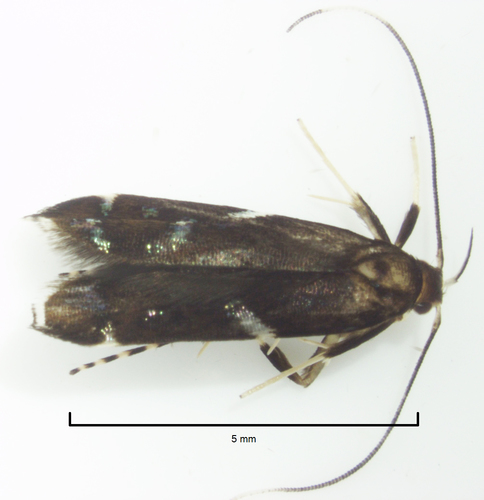
Hudson described the adult moth of this species as follows: The wingspan is approximately seven-sixteenths of an inch. The forewings are fairly elongated and oblong, with a considerably rounded tornus. They are a shiny coppery-brown, thinly sprinkled with black scales. There is a small silvery patch near the base, a broad oblique band starting on the costa at about one-third of the wing length that extends halfway across the wing, an irregular patch near the middle of the wing, and a curved sub-terminal band that is widest near the middle. All of these silvery-white markings glow with iridescent purple. The cilia near the wing apex are shining white with black tips. The hindwings are grey with coppery-brown reflections. The legs are black and banded with shining white, and the antennae have a broad white band located just before the apex. Hudson described adult Compsistis bifaciella moths as jewel-like.
This species is endemic to New Zealand, and can be found throughout the North Island. It inhabits native forest, and is also known to live in stands of Kunzea ericoides. Its larvae feed on leaf litter, and live inside a silk gallery either on the ground or within tree ferns. They pupate inside a dome-shaped cocoon coated with leaf litter, which typically rests on a dead leaf.